

I. OVERVIEW
1. To implement the annual teaching and learning quality assurance plan, the University of Social Sciences and Humanities, Viet Nam National University Ho Chi Minh City (USSH, VNUHCM) has collected student (ST) feedback on courses taught in the second semester (Semester II) of the 2023-2024 academic year as proposed by the faculty or those that had not been previously surveyed or had been surveyed prior to the 2019-2020 academic year.
2. The course survey questionnaire was reviewed, revised, and accepted in 2021, with adjustments and additions of content suitable for use with courses taught online (for most or all of the course duration). The questionnaire consists of 22 closed-ended questions covering 4 main topics: (1) information about the ST completing the questionnaire, (2) ST feedback on the course, (3) ST satisfaction level with the lecturer's teaching activities, and (4) ST overall satisfaction with the course.
The closed-ended questions use a 5-level Likert scale, with levels increasing from 1=strongly disagree/dissatisfied to 5=strongly agree/satisfied. Additionally, the questionnaire includes 1 open-ended question regarding specific recommendations for improving teaching quality so that ST can contribute further opinions if any (see Appendix IV).
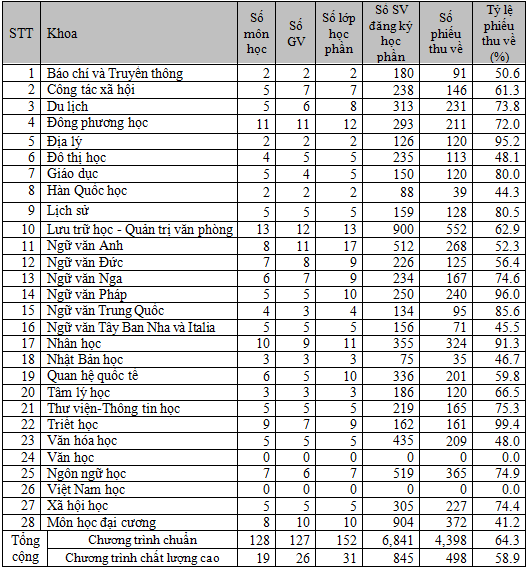
3. The survey was collected through Google Forms and the University's online survey software. To ensure the reference value of student feedback, the Quality Assurance Office only synthesized and analyzed data for course sections with a response rate of 40% or higher; specifically, 141 courses taught by 145 lecturers, corresponding to 4,896 student responses across 183 course sections (Table 1).
Table 1. Statistics on the number of courses and lecturers surveyed and processed in the second semester of the 2023-2024 academic year
II. SURVEY RESULTS
1. Students' general remarks on the course
In this section, ST expressed their level of agreement with statements about the course using a 5-level Likert scale, with the level of agreement increasing from 1 to 5. Accordingly, the mean value ranges are defined as follows:
- Strongly disagree = Mean from 1.00 to 1.80;
- Disagree = Mean from 1.81 to 2.60;
- Neutral = Mean from 2.61 to 3.40;
- Agree = Mean from 3.41 to 4.20;
- Strongly agree = Mean from 4.21 to 5.00
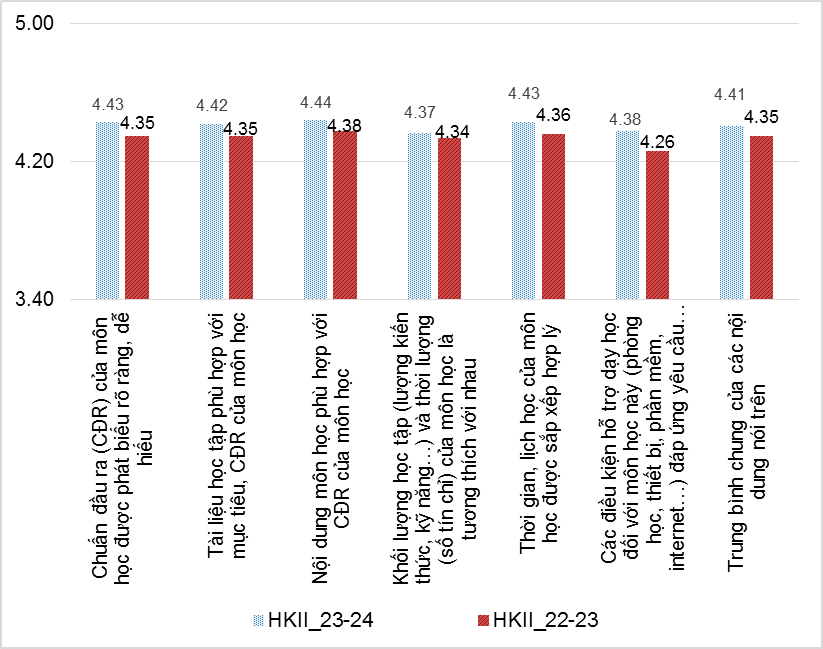
Chart 1. General remarks of ST on the course
The survey results synthesized in Chart 1 show that ST expressed a higher level of agreement compared to the Semester II survey of the 2022-2023 academic year for all items mentioned in the questionnaire. Among these, the item with the lowest level of agreement was “The study load (amount of knowledge, skills, etc.) and the duration (number of credits) of the course are compatible with each other”; the item with the highest agreement was “Course content is consistent with the course learning outcomes (CLOs)” (Chart 1).
2. Student feedback on the teaching activities of the lecturer in charge of the course
In this section, ST expressed their level of satisfaction with teaching activities using a 5-level Likert scale, with the level of satisfaction increasing from 1 to 5. Accordingly, the Mean ranges are defined as follows:
- Strongly dissatisfied = Mean from 1.00 to 1.80;
- Dissatisfied = Mean from 1.81 to 2.60;
- Neutral = Mean from 2.61 to 3.40;
- Satisfied = Mean from 3.41 to 4.20;
- Strongly satisfied = Mean from 4.21 to 5.00.
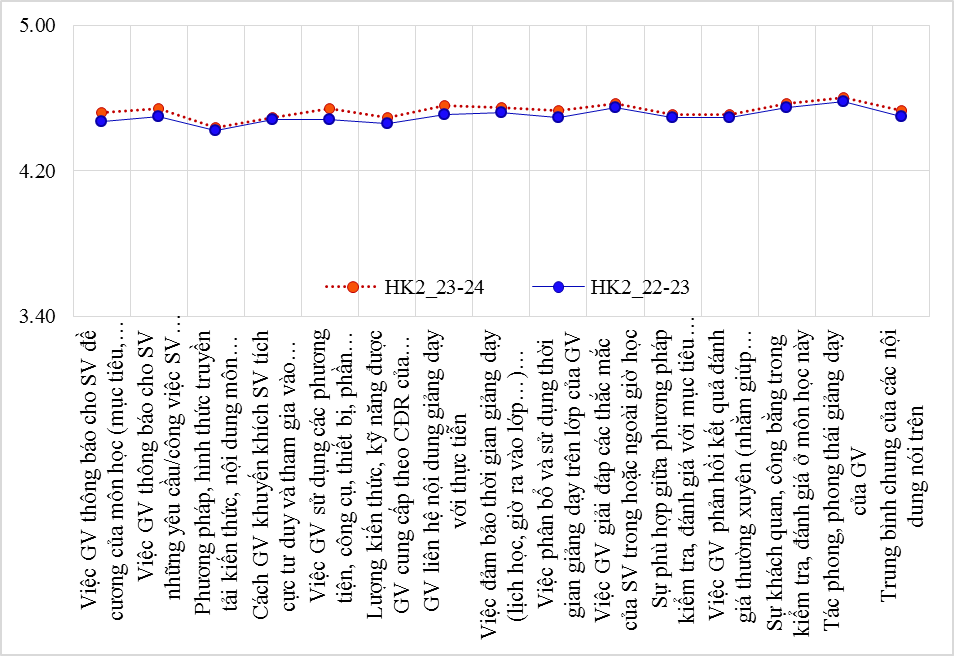
Chart 2. ST remarks on the lecturer's teaching activities
From the survey results shown in Chart 2, it can be seen that all evaluated items are at the “strongly satisfied” level. ST expressed a level of satisfaction quite similar to the Semester II survey of the 2022-2023 academic year for all items mentioned in the questionnaire.
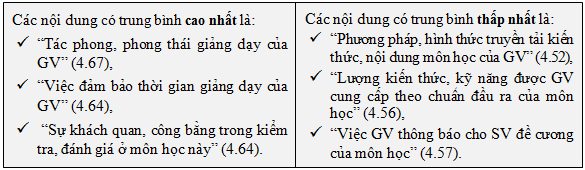
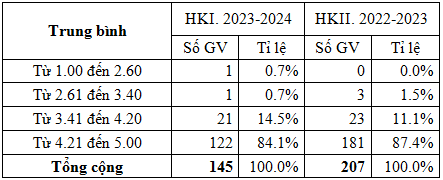
Table 2 below shows that the percentage of lecturers evaluated at the “strongly satisfied” level in the Semester II 2023-2024 survey was 84.1%, lower than in the Semester II 2022-2023 survey (87.4%). In this survey, 2 lecturers (accounting for 1%) received feedback with an average mean below 3.41 (corresponding to “strongly dissatisfied” and “dissatisfied” levels).
Table 2. Summary of evaluations of surveyed lecturer teaching activities
3. Overall student satisfaction with the course
Overall student satisfaction with the course is strongly satisfied with a mean = 4.36, equivalent to the survey results in Semester II of the 2022-2023 academic year (mean = 4.36). Table 3 below summarizes student satisfaction with the course by course section.
Table 3. Overall ST satisfaction with the course
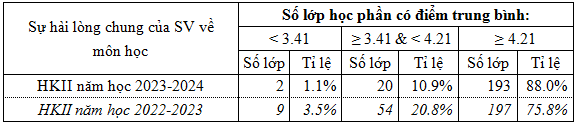
Table 3 shows that the percentage of course sections in which students rated the lecturer's teaching activities at the “strongly satisfied” level in the Semester II 2023-2024 survey was 88%, higher than in the Semester II 2022-2023 survey (75.8%).
Through correlation analysis, it can be concluded that overall student satisfaction with the course is closely correlated with satisfaction with specific content of the lecturer's teaching activities. In particular:
- Overall student satisfaction correlates highest with the items: “Lecturer's methods and forms of knowledge and course content delivery” and “Amount of knowledge and skills provided by the lecturer in accordance with the course learning outcomes”;
- Overall student satisfaction correlates lowest with the items: “Lecturer's use of teaching aids, tools, equipment, and software” and “Lecturer's answering of student questions during or outside of class hours”.
4. Student feedback through open-ended questions
There were a total of 262 suggestions from students through open-ended questions, including:
- 29 suggestions related to the general characteristics of the course,
- 9 suggestions related to class scheduling,
- 15 suggestions related to course learning materials,
- 150 suggestions related to lecturer teaching activities,
- 26 suggestions related to facilities and equipment serving the course,
- 33 suggestions related to course assessment and evaluation.
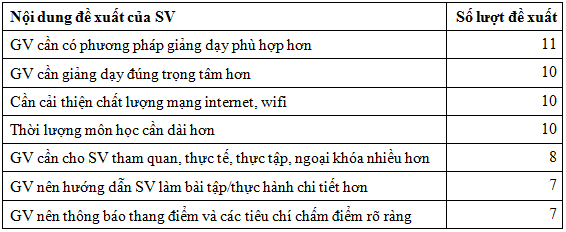
Table 4 below summarizes the most frequently mentioned suggestions from students.
Table 4. Most frequently mentioned student suggestions
Tài liệu đính kèm
Bài viết liên quan

3rd Training Session on Designing, Developing, and Measuring Course and Program Learning Outcomes

Completion of AUN-QA external assessment for the Bachelor of Cultural Studies and Bachelor of Literature programs