

Participating as presenters and facilitators in the training were Dr. Hoang Mai Khanh – Director of the Quality Assurance Office and MSc. Nguyen Hoang My Lan – Deputy Director of the Quality Assurance Office. During the training sessions, the presenters outlined core content related to the learning outcome framework, principles for designing course learning outcomes linked to PLOs, and methods for measuring and evaluating the achievement of learning outcomes through teaching, learning, and assessment activities.
The training content was designed to combine theory and practice, focusing on: (i) clarifying the alignment between PLOs, course learning outcomes, and course syllabi; (ii) formulating learning outcomes using a competency-based approach to ensure measurability; (iii) building a mapping matrix between learning outcomes, teaching content, and assessment methods; and (iv) using evidence to measure the level of achievement of learning outcomes. Beyond the presentations, participants engaged in direct discussions and hands-on practice using training materials and course syllabus templates provided by the Organizing Committee.
Through open discussion sessions, many practical challenges in building and reviewing course syllabi were addressed, contributing to a unified understanding and approach among the units. The training not only reinforced professional knowledge and skills for faculty and administrative staff but also created a foundation for synchronizing and improving the quality of training program design, serving self-assessment, accreditation, and continuous improvement efforts.
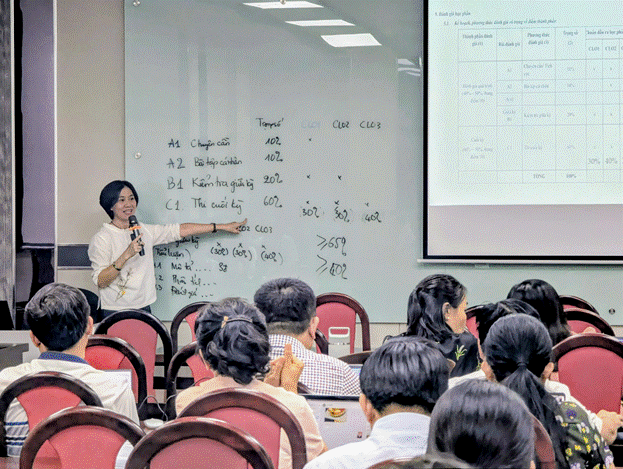
Dr. Hoang Mai Khanh – Director of the Quality Assurance Office, presenting the training content.
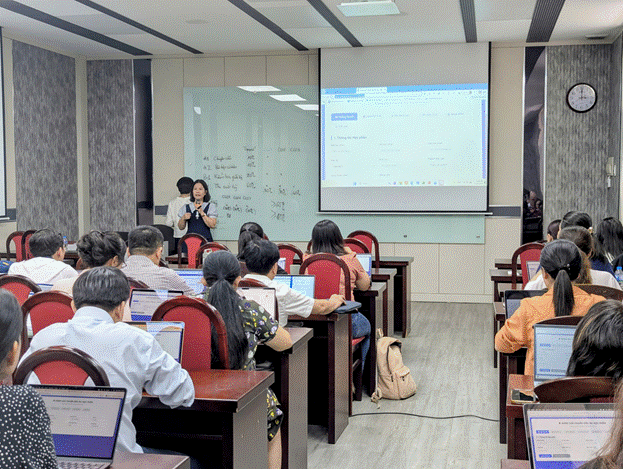
MSc. Nguyen Hoang My Lan – Deputy Director of the Quality Assurance Office, facilitating and discussing during the training session.
Concluding the program, the Organizing Committee acknowledged the serious participation and positive engagement of the learners. The training results are expected to be effectively applied to the practical development and adjustment of course syllabi and the implementation of training programs in the near future.
QUALITY ASSURANCE OFFICE