As Vietnam pushes ahead with reforming and streamlining the administrative apparatus, learning from global insights offers practical values. Responding to that need, the Center for Korean Studies at the University of Social Sciences and Humanities, Viet Nam National University Ho Chi Minh City (USSH-VNUHCM), held the conference “Korea’s Local Government Model and Lessons for Vietnam” on August 14, 2026. The conference examined how Korea’s local autonomy system works in practice and thereby, proposed solutions for Vietnam on decentralization, delegation of power, digital transformation, and streamlining the administrative apparatus.
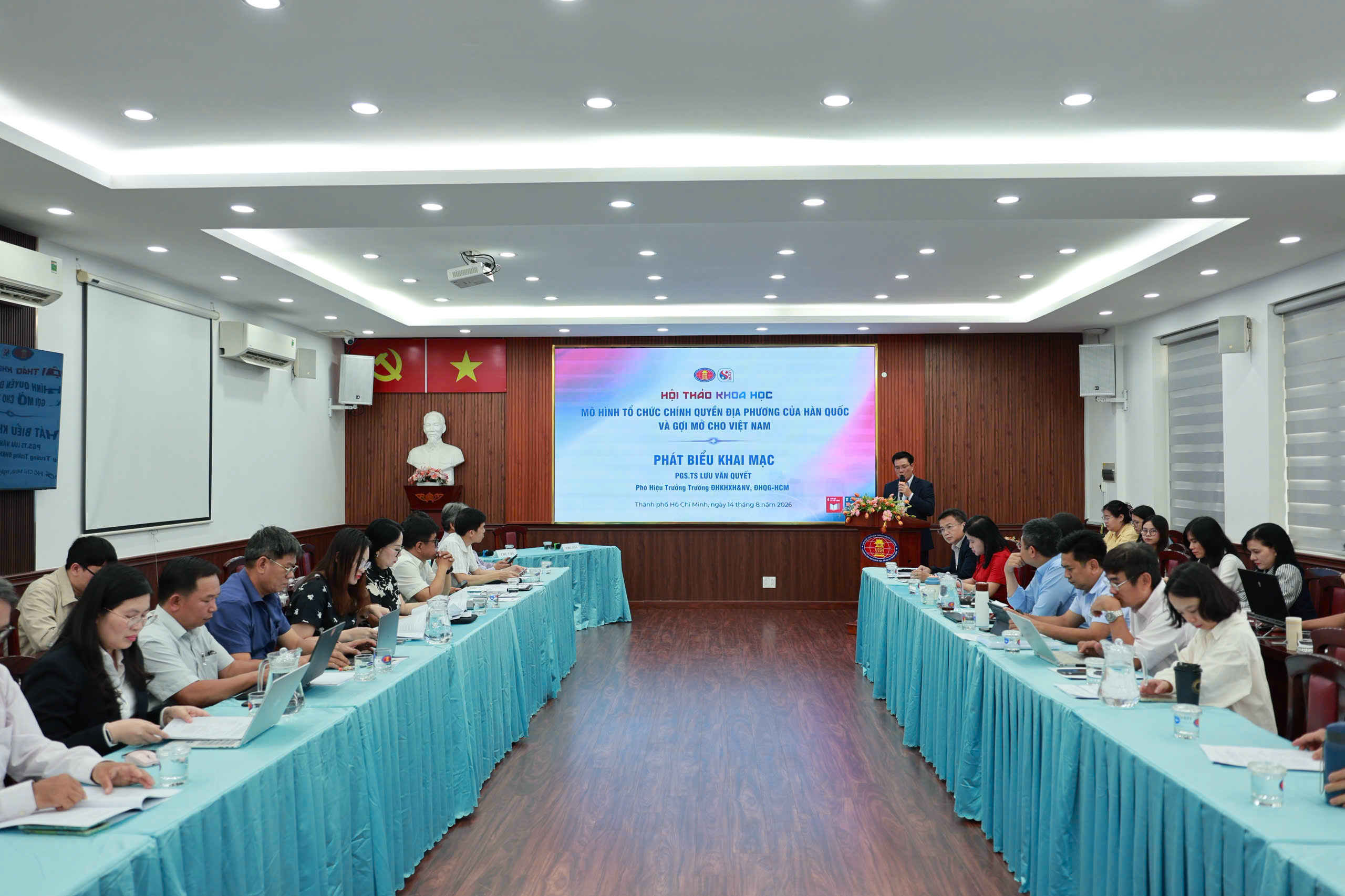
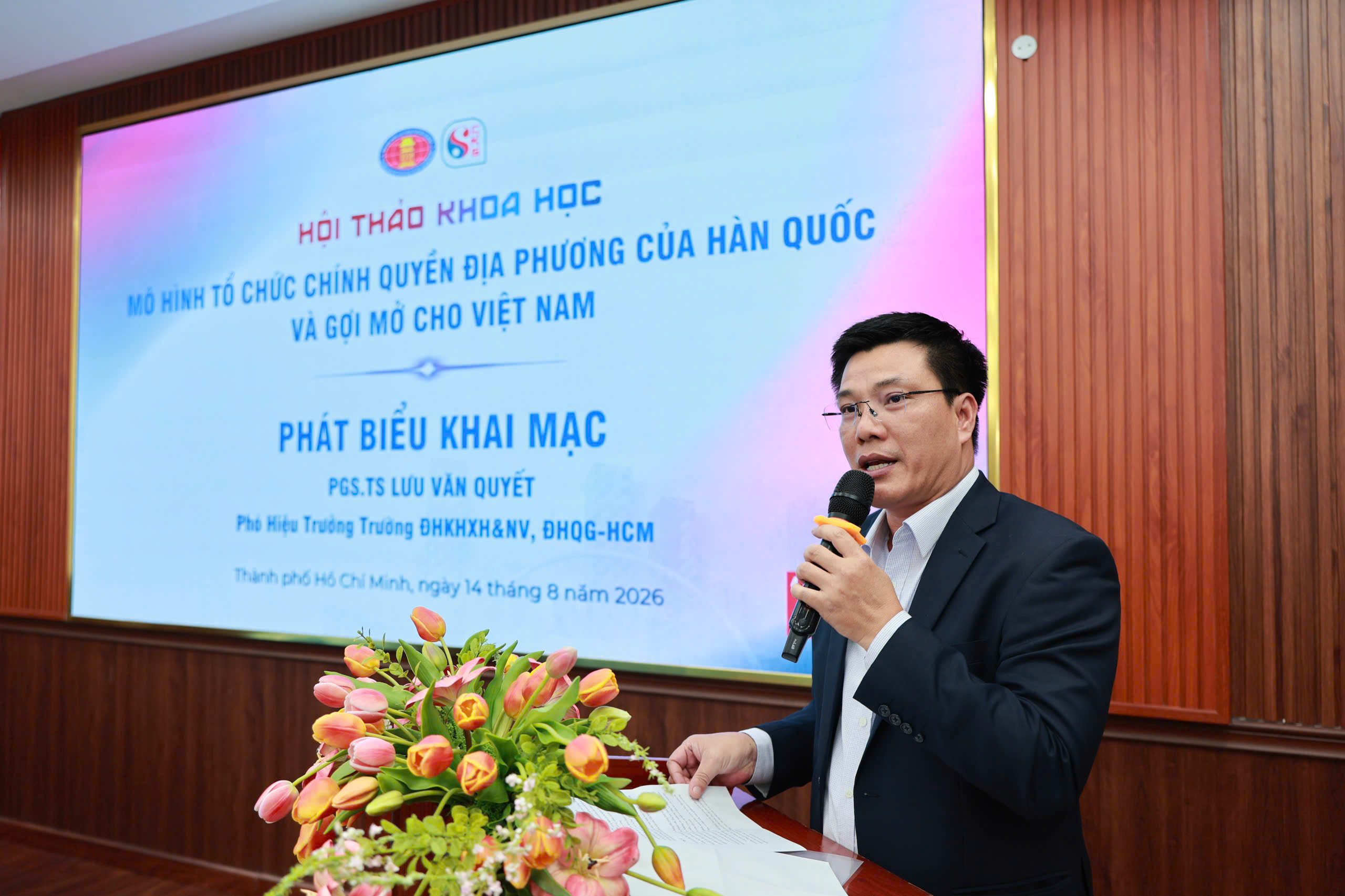
In his opening remarks, Assoc. Prof. Dr. Luu Van Quyet, Vice President of USSH-VNUHCM, said Vietnam is moving toward a leaner administrative apparatus, with decentralization and delegation of power going hand in hand with stronger accountability. Korea, he noted, has successfully shifted from centralized governance to local autonomy, and its model offers valuable insights for Vietnam.
Praising the conference’s scale and connectivity, he expressed confidence that with scientists and experts from major agencies, research institutes, and universities, the event would bring about insightful discussion. “Our approach to studying international experience is not ‘mechanical copying,’” he stressed. “What matters is to delve deeper into the institutional and social conditions behind Korea’s success, then draw the lessons best suited to Vietnam’s socio-economic conditions and political system.”
In the keynote report, Assoc. Prof. Dr. Bui Hai Dang, Director of the Center for Korean Studies at USSH-VNUHCM, discussed Vietnam’s shift as it operates a two-tier local government model in certain special areas. Drawing on the submitted papers, the Organizing Committee outlined five main groups of issues for discussion. The first is the relationship between central and local governments, particularly which areas must remain under unified central management and which can be delegated to localities. The second is that decentralization must come with resources, following the principle that authority goes hand in hand with financial resources and accountability. The third is area-specific institutions, which would allow flexible governance for different types of space such as urban, rural, mountainous, and island areas. The fourth is digital transformation and streamlining, using e-government, public data, and AI to cut intermediate layers. The fifth is promoting citizen participation through transparent mechanisms that allow people to monitor and have a say on local matters.
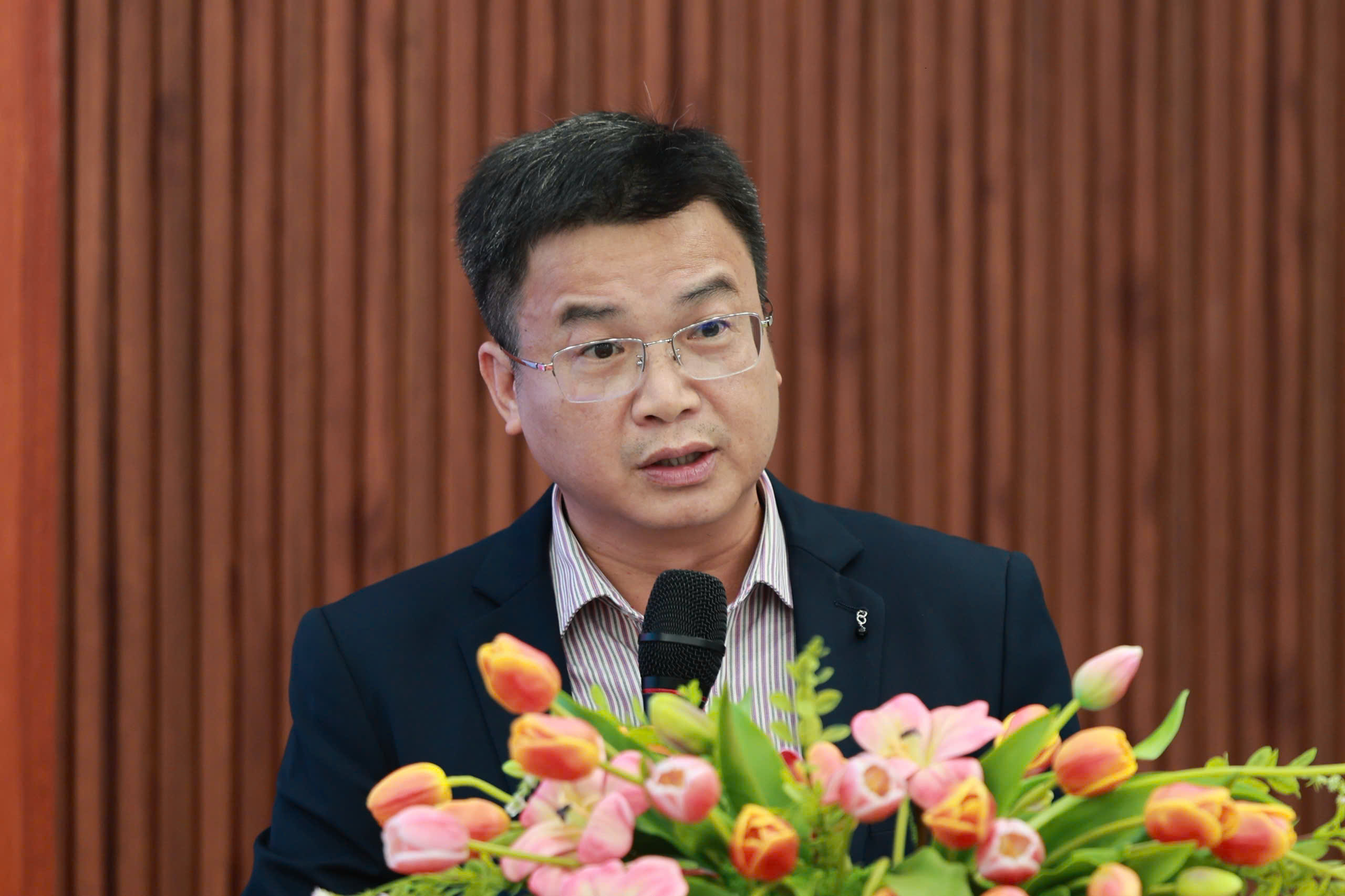
Opening the first session, Assoc. Prof. Dr. Nguyen Anh Cuong of the University of Social Sciences and Humanities, Viet Nam National University, Ha Noi, described decentralization as the territorial restructuring of public power. Drawing on Korea’s experience, he identified six components that must be designed in tandem: authority, resources, implementation capacity, inter-level and inter-local coordination, accountability, and power control. For Vietnam, the lesson is to align authority, resources, and responsibility, and to build a set of indicators to measure results.
From the perspective of apparatus reform, Assoc. Prof. Dr. Pham Hong Thai of Van Hien University outlined the stages of Korea’s local government reform from 1995 to the present. The early stage focused on reducing staff and merging administrative units, a form of mechanical downsizing; since 2010, the emphasis has shifted to optimizing functions, integrating data, and applying technology for smart streamlining.
Dr. Nguyen Thanh Trung, representing Fulbright University Vietnam, then analyzed Korea’s 1995 Local Autonomy Law through the lens of Oates’ Decentralization Theorem, pointing to a shift in accountability from the vertical (“upward”) to accountability to voters (“downward”). On that basis, he proposed four fiscal tools for Vietnamese urban governments: property tax, local income tax surcharges, land value surplus capture (TOD), and urban regulation fees.
The second session focused on implementation, digital government, and local external relations. Analyzing the autonomy of Korean local governments across four dimensions (organizational structure, personnel, finance, and digital governance), Dr. Le Tung Lam of Saigon University drew on the spirit of the 13th National Party Congress Resolution to propose solutions that would give Vietnamese local governments greater initiative.
Applying New Institutional Theory, Assoc. Prof. Dr. Pham Thi Kien, representing the University of Economics HCMC, analyzed Korea’s digital transformation through three institutional pillars: legal regulations, standardized interoperable data, and the apparatus’s implementation capacity. Dr. Tran Xuan Thuy, representing the HCMC Department of Foreign Affairs, presented the role of Korean local external relations in attracting investment, promoting trade, and spreading culture, and cited Korean cities’ overseas representative offices as a reference model for Vietnam.
Applying New Institutional Theory, Assoc. Prof. Dr. Pham Thi Kien from the University of Economics HCMC analyzed Korea’s digital transformation through three institutional pillars: legal regulations, standardized interoperable data, and the apparatus’s implementation capacity. Dr. Tran Xuan Thuy from the HCMC Department of Foreign Affairs presented the role of Korean local external relations in attracting investment, promoting trade, and spreading culture, and cited Korean cities’ overseas representative offices as a reference model for Vietnam.
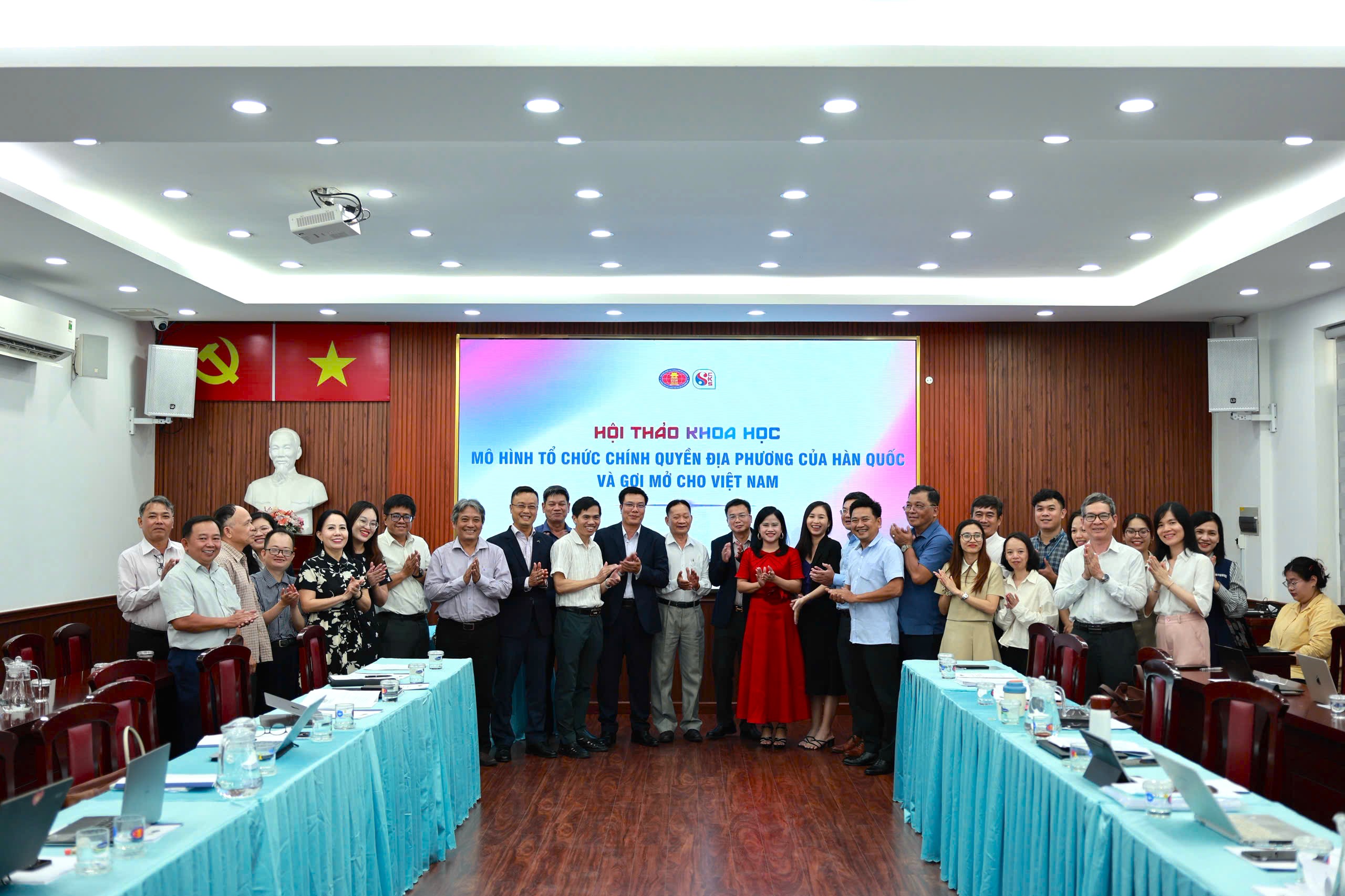
The conference carries practical significance in systematizing the theoretical basis and empirical data on Korea’s local autonomy model. By analyzing institutional, fiscal, digital governance, and local external relations dimensions, it provides scientific arguments for research, policymaking, and the organization of local government in Vietnam.