

Scientific Seminar on Specific Management and Financial Mechanisms for Social Sciences and Humanities Tasks
On August 12, 2026, the University of Social Sciences and Humanities, Viet Nam National University Ho Chi Minh City (USSH-VNUHCM) collaborated with the Department of Social Sciences, Humanities, and Natural Sciences under the Ministry of Science and Technology to organize the seminar “Specific Management and Financial Mechanisms for Social Sciences and Humanities Tasks.” The seminar served as a forum for scientists, experts, managers, and representatives of research and training organizations to exchange views and contribute to improving specific management and financial mechanisms tailored to the characteristics of social sciences and humanities.
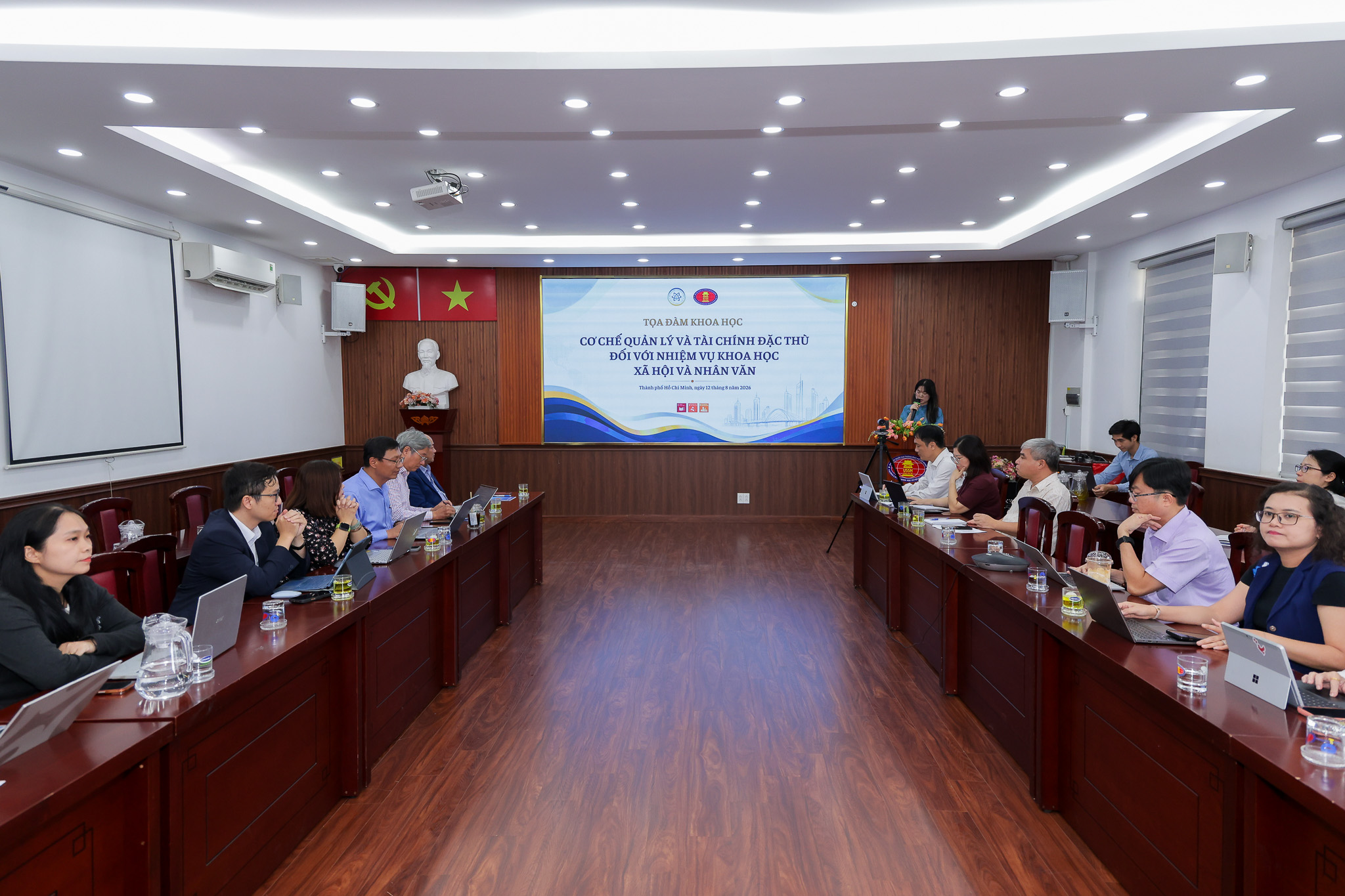
In his opening remarks, Dr. Phan Thanh Dinh, Vice President of USSH-VNUHCM, stated that amid reforms in the management of science, technology, and innovation, the question is not only how much to invest but, more importantly, how to invest, so that resources create knowledge, policies, and lasting development values. In the field of social sciences and humanities, many research products cannot be viewed simply through commercial value or immediate results. They may be development models, policy recommendations, historical or cultural studies, or insightful forecasts. Therefore, research on management and financial mechanisms should build on the specific nature of each type of task, with clear values and objectives.
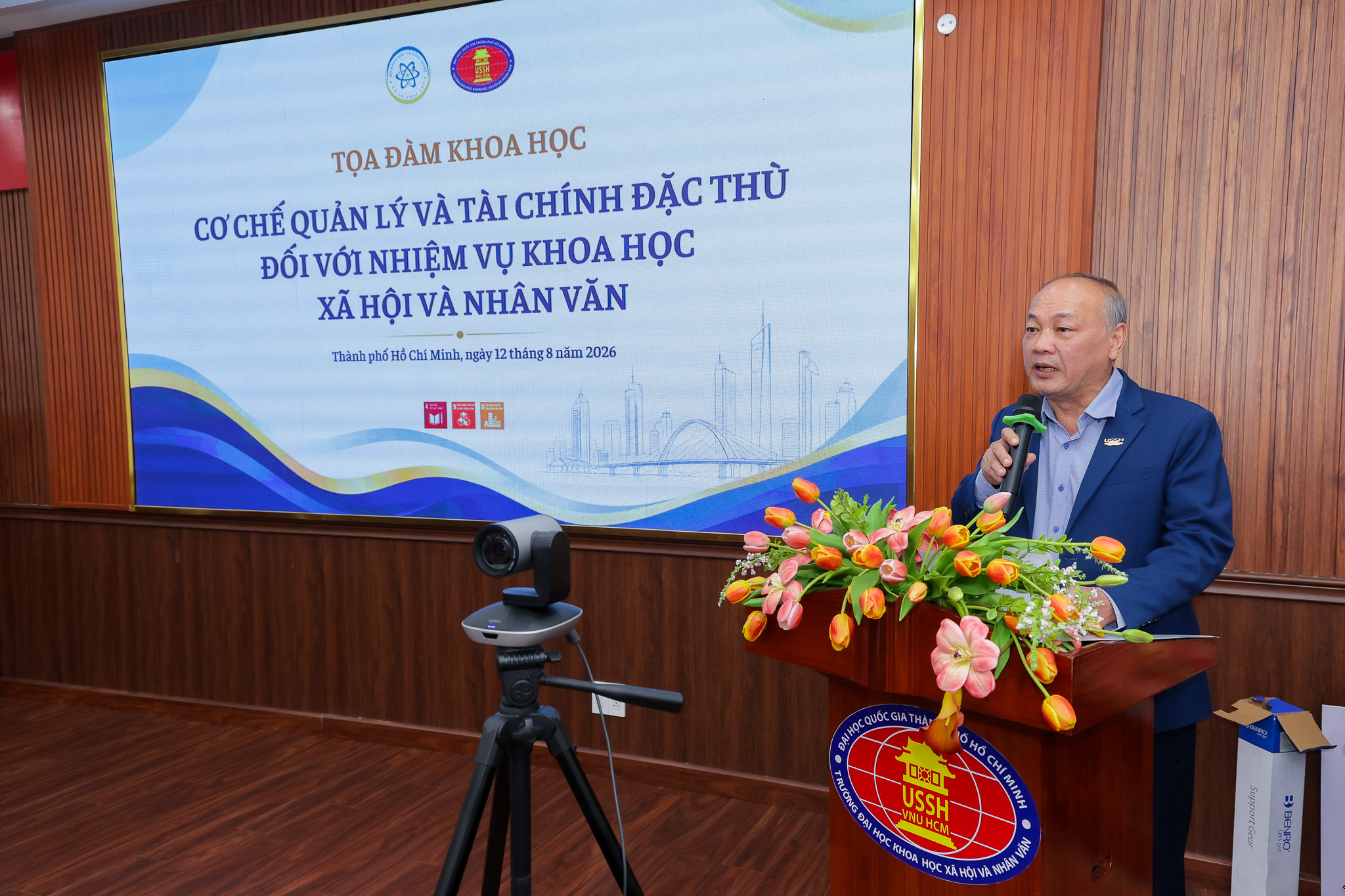
Based on this reality, Dr. Phan Thanh Dinh raised three key issues: “correct classification for proper management and investment”; result-oriented financial mechanism reforms; and strengthening links between research and policy. Accordingly, research results should be transformed into insights, evidence and recommendations for policy formulation, implementation, and evaluation. He also emphasized the role of universities and research institutes in connecting knowledge with development practice and researchers with management agencies, thereby helping bring social sciences and humanities knowledge into solving practical problems of Ho Chi Minh City, the southern region, and Viet Nam.
Presenting at the seminar, Dr. Nguyen Thanh Trung, Deputy Director of the Department of Social Sciences, Humanities, and Natural Sciences under the Ministry of Science and Technology, pointed out several problems in the current mechanisms. First, there is no task classification framework for management and financial mechanisms. Second, there is currently a uniform mechanism applied to tasks that differ in nature. Third, current norms and procedures do not fully reflect intellectual labor, data, surveys, and experts. And finally, evaluation and acceptance are still focused on papers and procedures rather than on the actual applications and their impact.

On that basis, the report proposed tailoring specific financial mechanisms for each type of social sciences and humanities task instead of building one general mechanism for all. Together with classifying tasks before choosing the appropriate management and financial mechanisms, the new approach aims to shift from input control to management aimed at results, risk, and impact, and to increase autonomy alongside transparency, account and post-audit.
According to the proposal, the Multidimensional Classification Framework for social sciences and humanities tasks is built on several dimensions: objectives and products; investment methods; human resources and organization; and scope and duration. A task can be identified using multiple dimensions to select suitable management and investment methods.
The report also proposed a “task type - financial mechanism” matrix, in which each group of tasks, such as basic research, policy research, sociological surveys, database building, indicator systems, development of strong research groups, or scientific products serving public interests, is tied to different investment methods, funding methods, and evaluation criteria.









At the seminar, invited experts discussed the suitability of the Multidimensional Classification Framework; the types of tasks that should be prioritized for specific financial mechanisms; criteria for distinguishing policy-oriented research; mechanisms for evaluating the use and impact of research results; and the contents that need to be institutionalized or guided in the coming time.