STEAM Education - Foster Knowledge, Innovations, and Develop Skills in the 4th Industrial Revolution
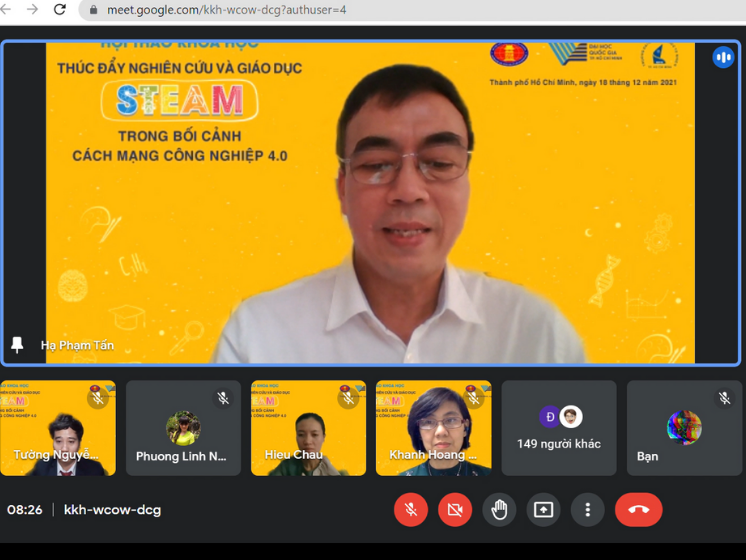
On the morning of Dec. 18, 2021, 2 representatives of 2 major science disciplines, the University of Social Sciences and Humanities (USSH) and the University of Science (US), organized the national scientific conference on the theme of “Promoting STEAM research and education in the 4th industrial revolution” on Google Meet. The conference attracted over 200 delegates: STEM/STEAM experts, researchers, faculty staff, learners of all levels, as well as state and local educational authorities.
In his opening remarks, Dr. Pham Tan Ha-Vice-Rector of USSH asserted that though the 4th industrial revolution brings about advanced innovations at an unmatched pace, it also poses big challenges for educators to propose effective educational orientations and strategies. Hence, STEAM education is considered an effective approach in fostering knowledge, innovations and developing skills.
The vice-rector highlighted that this was the first collaboration of USSH and US to organize a national educational conference. “This is a wise move to adapt to the interdisciplinary and transdisciplinary trend in education and to build an effective system for VNU-HCM”, he shared.
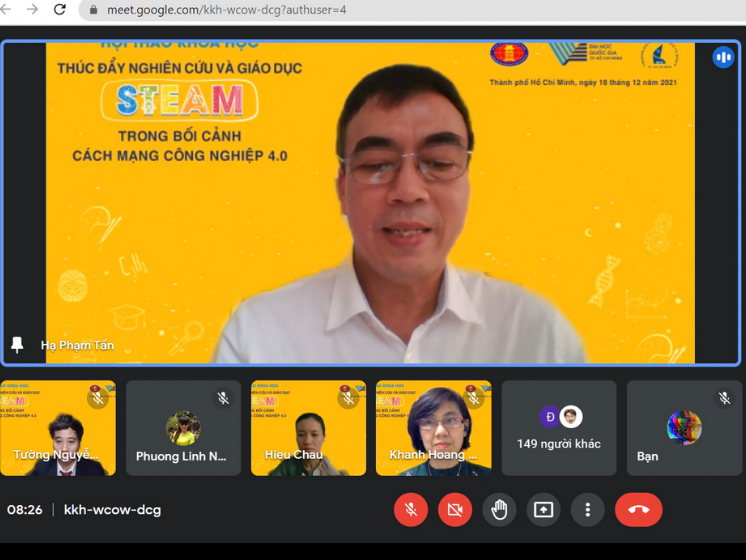
Dr. Pham Tan Ha - Vice-rector of the USSH delivered opening remarks at the conference - Picture: Screenshot
After that, Assoc.Prof.-Dr. Tran Minh Triet, Vice-rector of the US, in his welcoming remarks, reiterated the necessity of integrating the science-based learning of STEM with the creativity of Arts. Thus, “STEAM focuses not only on scientific knowledge and skills but also on practical and helpful application”.
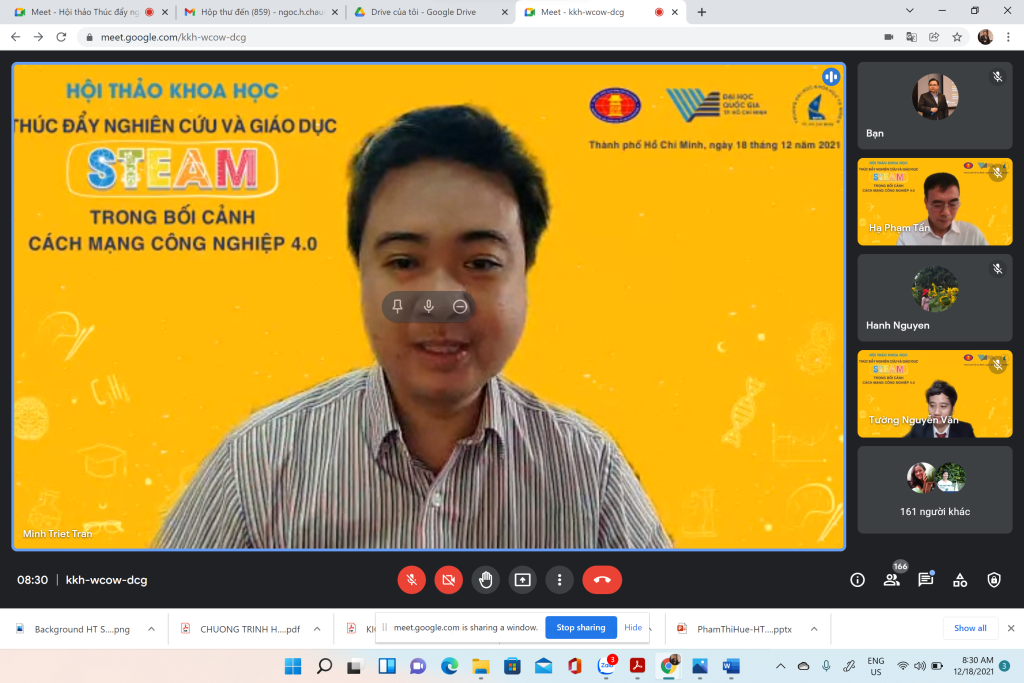
Assoc. Prof.-Dr. Tran Minh Triet - Vice-Rector of the University of Science delivered welcoming remarks - Picture: Screenshot
What is STEAM education?
At the conference, Dr. Vu Quang Tuyen (from the US), in his discussion: “Basic concepts of STEAM education”, presented some hallmarks of STEM education (Science, Technology, Engineering, Math) or STEAM (with Arts):
- Focus on practical issues and develop STEAM interdisciplinary approach accordingly
- Adopt technical practice and design related to learned technology.
- Utilize student-centered approaches to encourage autonomous learning
- Focus on group activities and communicating skills, since collaboration is necessary to address problems
This modern and effective educational model can boost students’ motivation, help them prepare for their future, and meet the social requirements of the 21st century. Thus, this model is drawing attention from many countries, including Viet Nam.
STEAM model application
STEAM model is currently applied in all levels, from kindergarten to tertiary education. Not only does STEAM focus on delivering scientific knowledge, but it also educates students on social sciences and humanities topics such as protecting maritime sovereignty and Viet Nam’s borderlines. Besides, the STEAM approach is used in publishing braille books and teaching visually-impaired students
In her discussion on the theme of “Promote students’ motivation through STEM/STEAM education”, Dr. Hoang Mai Khanh (from USSH) further underscored that motivation is amongst the factors that contribute to students’ academic performance. She also introduced MUSIC- the study motivating model, including 5 factors:
- eMpowerment: Students’ self-control over their learning
- Usefulness: The practicality of learning content
- Success: The self-belief of students to achieve satisfactory results if they work hard
- Interest: The engagement of students in a lesson
- Caring: The dedication of teachers towards students
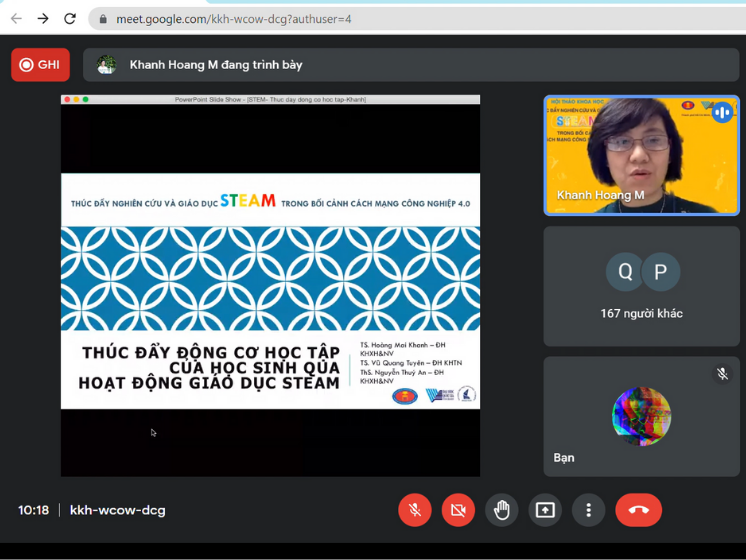
Dr. Hoang Mai Khanh (USSH) presented her discussion. Picture: Screenshot
Through discussions about STEAM education, Dr. Hoang Mai Khanh stated: “STEAM is important because it maximizes learners’ ability and increases their social responsibilities, hence the learners can adapt to any work environments”.
Nguyễn Quỳnh
Translated by: Tiên Vũ