In 1973, “content creator” or “social media brand manager” were all unfamiliar phrases. Fifty years later, these became jobs that are sought after by a lot of youths. So, if a young person starts his career at this time and continues to work for the next 50 years, what will be the skills needed to help him cope with the challenges in today's rapidly changing world?
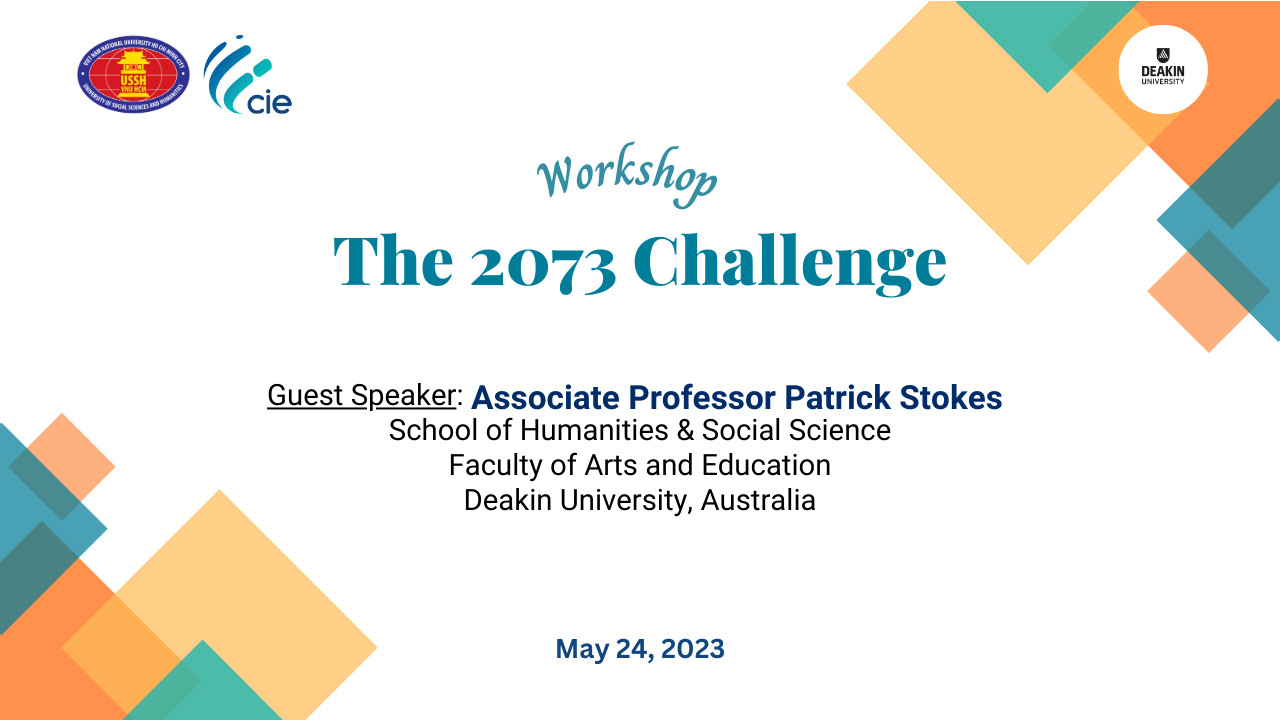
This is the topic discussed in the workshop "The 2073 Challenge" which was held on the morning of May 24th, 2023. The Center for International Education organized the workshop in collaboration with Deakin University for students studying in the international 2+2 joint program in Communication (majoring in Journalism) and International Relations.
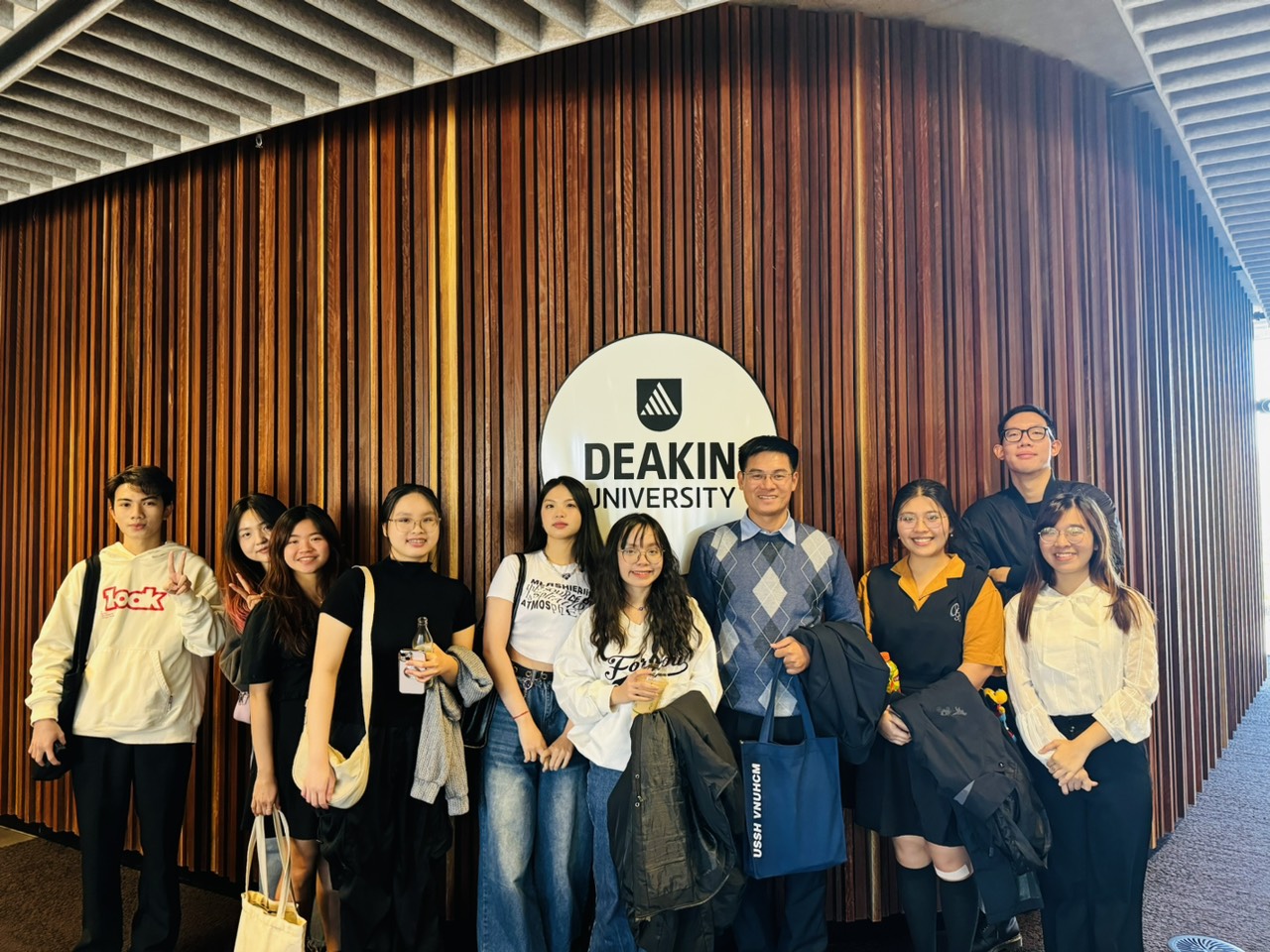
The workshop welcomed the presence of Dr. Tran Thanh Huong - Standing Deputy Director of the Center for International Education, Ms. Nguyen Viet Thuy Trang and Ms. Nguyen Vo Minh Thu - Representatives of Deakin University Vietnam Office, together with two special guests from Deakin University – Assoc. Prof. Dr. Patrick Stokes, Associate Head of School of Humanities and Social Sciences, Ms. Brianna Watt, Manager, Partnerships and Engagement, and more than 30 joint program students in Communication (Journalism) and International Relations.
At the workshop, students of the international 2+2 joint program in Communication (Journalism) and International Relations in association with Deakin University, Australia were very intrigued by the topic of future career guidance through questions such as: “What skills are necessary for future careers?” “What advice do you have as a 21st-century young person for those who started their career in the '80s?” etc. Thereby, students also shared persuasive personal viewpoints and judgments through the theory found in the curriculum in Vietnam.
Assoc. Prof. Dr. Patrick Stokes said: “If we start our career at this period, it is expected that we will work for nearly fifty years. But think about it, a lot of the jobs and challenges we face today are concepts that were completely foreign 50 years ago. So, how can we prepare for a future we can't predict accurately? One way to answer this question is through higher education. The purpose of higher education is not to obtain a degree or acquire knowledge, but to learn problem-solving skills. In diverse multidimensional fields such as International Relations or Journalism, the benefit these programs bring to learners is not simply memorization of events, but being shaped into a person who can thrive in any situation no matter what changes.”
In addition, having understood students' concerns about career opportunities after graduation, Ms. Watt introduced the “Employability Sequence” program which includes courses to help students experience the real labor market and employer demands.
Students in the program were excited to participate in discussions and receive detailed feedback on questions about the transfer to Deakin University regarding education and issues related to living and working opportunities in Australia. In the future, the Center for International Education will continue to cooperate with partners to organize more useful workshops for international joint program students.