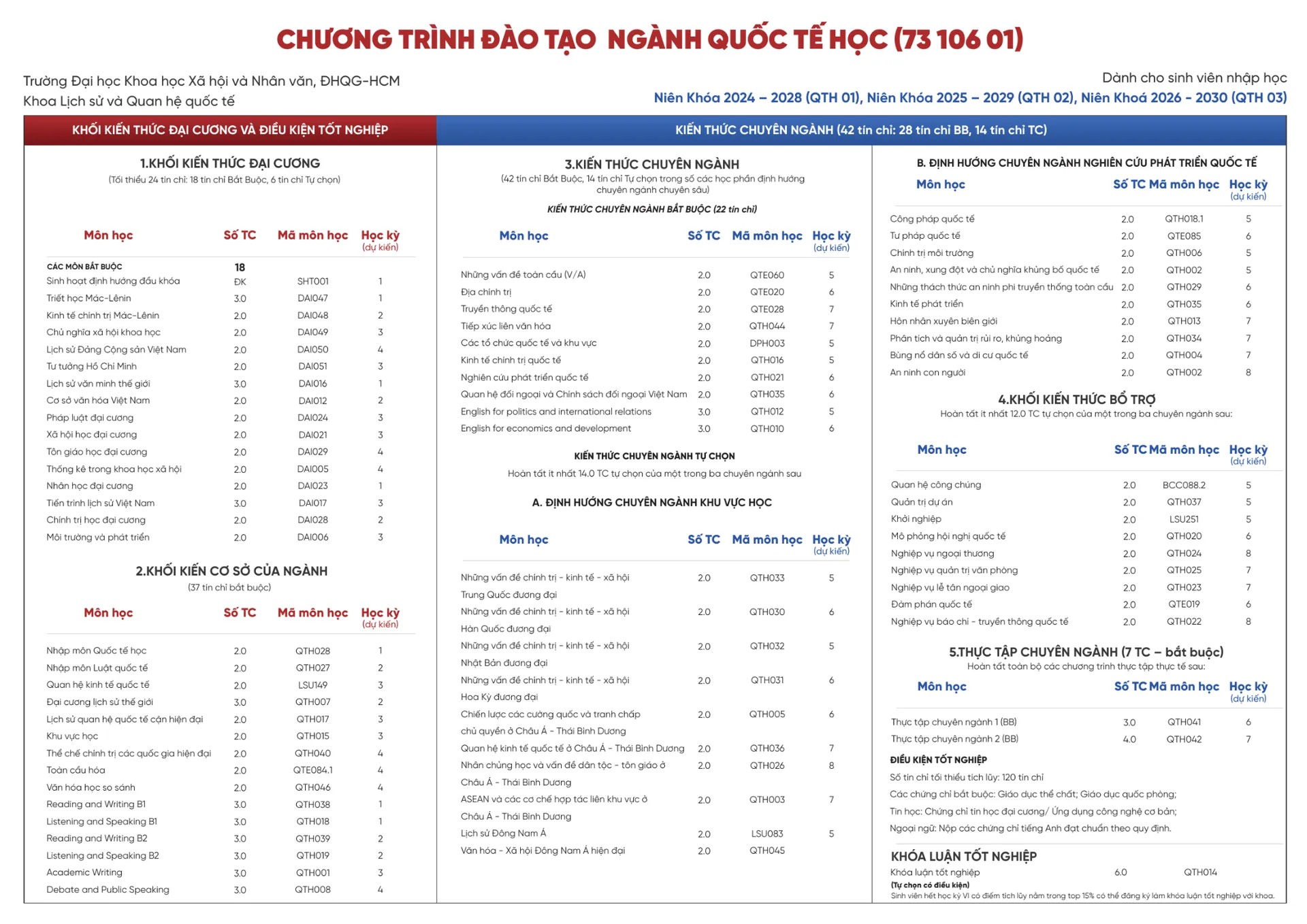
The International Studies program at the Faculty of History and International Relations, University of Social Sciences and Humanities, Viet Nam National University Ho Chi Minh City, aims to equip students with an interdisciplinary knowledge foundation, research competence, and the ability to approach international issues from multiple perspectives. With two concentrations in Area Studies and International Development Studies, the program helps learners step-by-step explore the world, understand the connections between nations, and identify Viet Nam's position in regional and global contexts.
The program is built upon the philosophy of "Educational philosophy: Whole person - Liberal - Multicultural Education". Accordingly, the learning process combines knowledge acquisition with the cultivation of independent thinking, critical reasoning, and a spirit of respecting differences. Students are encouraged to ask questions, connect knowledge across fields, and develop self-study capabilities to adapt to changes in international life.
In the initial stage, students engage with general knowledge modules to build a foundation in social sciences and humanities. Courses in history, culture, law, along with electives in sociology, anthropology, political science, environment, and development, help learners establish a base for exploring international issues in relation to humans and society.
Building on that, the core major knowledge block introduces students to modules such as Introduction to International Studies, Introduction to International Law, International Economic Relations, Modern and Contemporary History of International Relations, Area Studies, Globalization, and Comparative Cultural Studies. Through each module, learners gradually form a systematic perspective, knowing how to place a nation, event, or phenomenon within its historical context and the vast network of international interactions.
Foreign language proficiency is emphasized throughout the program. From reading, writing, listening, and speaking modules at B1 and B2 levels, students continue to practice academic writing, debating, and presentation skills. English modules on politics, international relations, economics, and development assist learners in accessing specialized materials, presenting arguments, and discussing international issues in English.
In the specialized knowledge block, students explore global issues, geopolitics, international communication, intercultural contact, international and regional organizations, international political economy, international development studies, as well as Viet Nam's foreign affairs and foreign policy. These contents help connect foundational knowledge with specific issues, while creating a basis for learners to choose an in-depth study path that aligns with their interests.
With the Area Studies concentration, students focus on studying countries and regions through political, economic, social, cultural, and international relations issues. Modules on China, Korea, Japan, the United States, Southeast Asia, and the Asia-Pacific help learners understand the characteristics of each research space, while identifying the links and interactions between nations and regions.
With the International Development Studies concentration, students approach issues regarding development economics, environmental politics, human security, international migration, and non-traditional security challenges. Additionally, modules on international law, conflict, risk management, and crisis management expand analytical bases, helping learners examine development issues in relation to policy, security, and social life.
The program also creates conditions for students to practice application skills through elective modules such as Public Relations, Project Management, International Conference Simulation, International Negotiation, Diplomatic Protocol Skills, and International Journalism and Communication Skills. Two specialized internship modules are opportunities for learners to access real-world environments, apply knowledge, and step-by-step determine their own development path.
Students must accumulate a minimum of 120 credits and meet graduation requirements for physical education, national defense education, informatics, and English as prescribed. Students who meet the program's conditions may register for a graduation thesis to develop in-depth research competence.
Through the combination of interdisciplinary knowledge, foreign languages, and practical experience, the International Studies program aims to help students understand the world with scientific thinking, know how to listen to different perspectives, and proactively apply their knowledge. This is the foundation for learners to continue studying, researching, and developing in an environment with international elements.