TS. Tran Mai Nhan
For a woman, having to break away from her family and her country to start a new life and an entirely new working environment in a foreign land is no small challenge, especially when she is no longer young.
I began this challenge when I was sent by the Faculty and the University to teach at Chungwoon University, Korea. This is one of the "partners" that has had a close relationship with the faculty for many years. The university is located in Hongseong city, Chungnam province, about 150 km from the capital, Seoul. Every year, Chungwoon University sends students to study in the 2+2 or 3+1 joint program at the Faculty of Vietnamese Studies and invites lecturers from the Faculty to teach Vietnamese language and culture to the students of the Faculty of Vietnamese Studies at their school. I am the 3rd lecturer from the faculty to have the honor of "carrying the bell to ring in a foreign land." Therefore, unlike trips for tourism, sightseeing, or enjoying the flavors of Korea, this trip was truly long days for a woman like me to overcome challenges to integrate into life in a foreign land.
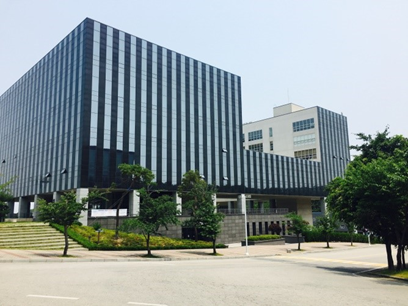
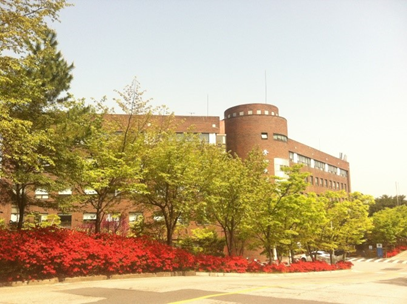
Chungwoon University (Hongseong Campus, Chungnam)
Adapting to the weather and loneliness
The Land of Kimchi welcomed me with biting cold but warm human affection. I was received as a "VIP guest" the moment I stepped off the plane. Everything had been prepared and carefully guided by staff who were always respectful and dedicated.
For a long time, I had dreamed of having my own space to work, to research, and to be able to calmly think about the things that needed thought. After more than 20 years in the teaching profession, for the first time, I saw my dream come true. The Korean people value education; they truly uphold the spirit of "respecting the teacher and valuing the tradition." Therefore, the way the host university prepared and took care of everything for me, from accommodation to a private, fully equipped office, was perhaps just normal for them. But importantly for me, for the first time, I felt that a Vietnamese woman had "value" because she was respected and cherished while in a foreign land, not just in the position of a lecturer.
But then, after the warm reception, when I was left alone in an empty room, staring through the window at the snow rain blanketing everywhere, snow covering the roofs, trees, and cold, deserted roads, and listening to the wind whistling in gusts over the bleak pine hills behind the house, it was also the first time I felt incredibly lonely and confused, because there were so many things I had to face, so many boundaries I had to overcome...
First and foremost is adapting to the weather and overcoming loneliness.
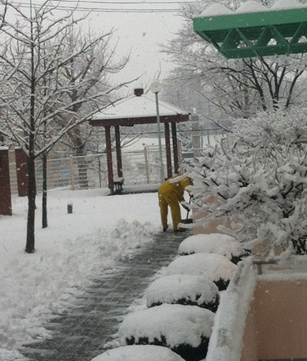
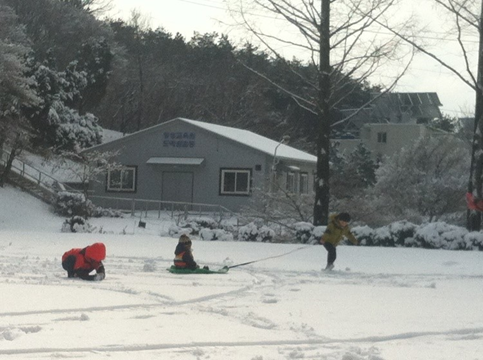
The Land of Kimchi - Snow-covered winter
Before setting foot in the Land of Kimchi, I had never seen snow. So this was snow, at negative 7 degrees Celsius. Whenever going out, I had to be equipped with 5-6 layers of clothing of all kinds, with a system of woolen hats, scarves, gloves, socks... Snow covered the paths, snow moved on cars, snow piled up and packed thick on the steps into the house and even on the railings... But the strange thing is that the snowstorms did not stop human activity; on the contrary, it seems everything became stronger. Houses, trees struggling under the snow, cars carrying the weight of snow, sanitation workers hunched over sweeping snow regardless of the bitter cold, so pedestrians wouldn't slip... Meanwhile, the guest just looked and felt heart-numbed, the whole body as if frozen solid. My heart suddenly thought, I don't know how many harsh winters like that have passed in their lives? Perhaps, the harshness of the climate, of the weather, is also a factor contributing to making their nation stronger and more resilient?
I told myself that I would also firmly get through the entire winter.
And then winter had also passed...
Getting familiar with technology and language
In Korea, everything is almost automated and technologized, from using bank cards, making payments when shopping, and means of transport to using equipment systems in classrooms, offices... Everything was very strange and new. Therefore, I had to find out for myself, grope, and get familiar with everything, because I knew I was in a "position" where I was not allowed to be clumsy or inept. Just for the task of taking attendance of students with automated software, I also had to learn and operate it proficiently. Each lecturer and student is issued an ID and password to access the school's website. Upon entering the class, the first thing is for the lecturer to log into the e-class system and select the class code. A list of students will appear on the screen. After the teacher presses the attendance button, a code specifically for that lesson will appear, students will log into the system with their personal smartphones and enter that code to mark their presence. When students finish taking attendance, a red seal (confirming presence) will appear by their names and student IDs. The lecturer checks the number of students present in the class corresponding to the number of red seals displayed and presses the finish attendance button. It is not just every day, but every single period, teachers and students must perform such an attendance operation. This method is indeed troublesome but also quite interesting, especially as students cannot ask friends to take attendance for them or complain to the teacher about their absence or lateness.
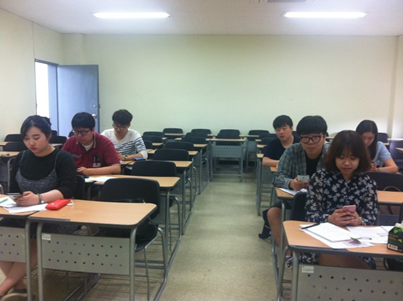
Students taking attendance on Smartphone
But truly, the biggest difficulty when living in Korea was not in getting familiar with technology but in the maximum use of their national language and the limitation of using English. From machinery to the names of products, notice boards, signs, everything is almost written only in Korean, occasionally one might see signs in English. And only in big cities or places that frequently transact with foreigners do people use English. Therefore, a guest from afar like me was no different from a blind person walking at night... So, there was the story of going to the supermarket to buy soy sauce but ending up with fish sauce, buying a gourd but getting a white radish, buying frozen beef but mistaking it for pork... So, there was the story of before going to the supermarket, having to ask "Doctor Google" for advice then taking a picture of the product name just to show it to the seller. Then going to eat at a restaurant is the same. And so, there was the story of every night coming home, turning on the internet to grope and learn Korean...
Observing and integrating into the culture
Actually, in terms of geographical distance, Korea is not too far from Vietnam, but in terms of culture and lifestyle, there are many differences that when "entering the house," we cannot help but "follow the customs." For example, in social interactions, Koreans often bow when meeting. In eating, they often do not lift the rice bowl, do not place the spoon face down; when drinking alcohol, one must lift with two hands and turn the face away, etc. Especially, in daily life, what we cannot help but learn from them is the "waste disposal culture." This is a country with very strict waste disposal and sorting principles: general waste, food waste, recyclable waste, large-sized waste. Garbage bags are also divided into many types: general type, type used for destruction, and type reserved for food. And the colors of garbage bags in each locality are also different...
Learning the waste disposal culture is first of all not to "break the law," and then not to "ruin the face" of us Vietnamese people. When I first arrived, I often stood at the 3rd-floor window of the building, observing how people discarded trash. I was very impressed by the image of a professor in a suit, carrying a bag of trash to the gathering point, then carefully and meticulously taking out each type to put into different bins, then getting into his car to go to school, or the image of the security guard every day checking the trash bins, meticulously removing each label, crushing each water bottle, then arranging them into large bags, tying them neatly, and bringing them to the side of the road for the garbage truck to come and take them away for processing...
There will be a thousand and one things to learn when living in a foreign land and many challenges that you have to overcome. But perhaps, for a woman, overcoming sadness, loneliness, and the feeling of being "countryside" to integrate into life in a foreign land is truly a big challenge. Because suddenly you have to leave behind the burden of family with so many worries; suddenly you are separated from the "herd" and yearn to hear the calls for coffee every afternoon... And the best way to overcome those challenges is to be confident and to get out of your private space to observe - learn and experience. This is what will help you understand more about the culture, history, and the lives of the people, especially the lives of Vietnamese women in foreign lands...
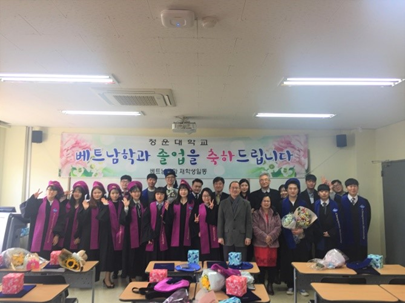
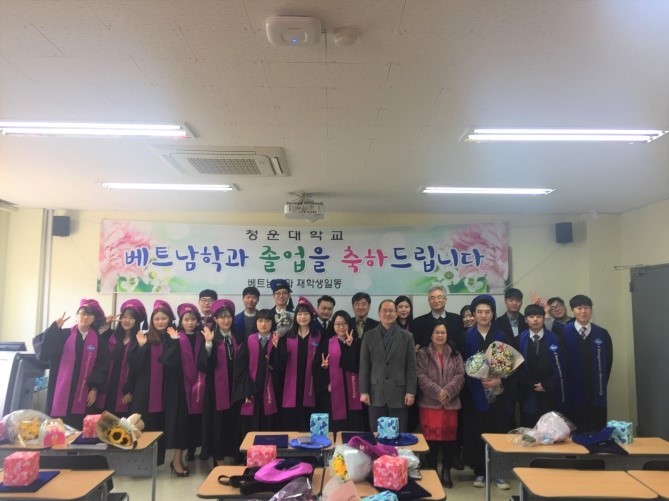
Taking a photo with students of Chungwoon University at the graduation ceremony - 2018
In any case, I also feel luckier than many other women when living in a foreign land without having to struggle for a living. I just try to fulfill the responsibilities of a lecturer, trying to be careful in every word, action so as not to affect the reputation and quality of the Faculty and the University. The time living and working in the Land of Korea can be said to be the most precious time in my teaching life. I feel that I have received too much kindness from the "family" of the Faculty of Vietnamese Studies and from this "Nhan Van" (Humanities) school to have interesting experiences, to learn more and gain many valuable experiences from friends and colleagues. Therefore, deep down in my heart, I always appreciate these sincere affections and do not forget to reserve for the women who are struggling to make a living in foreign lands, love, and sincere admiration. Because they have overcome many storms to become successful Vietnamese women in Korea./.
Ho Chi Minh City, September 2018
Bài viết liên quan