MA. Tran Thi Kim Anh
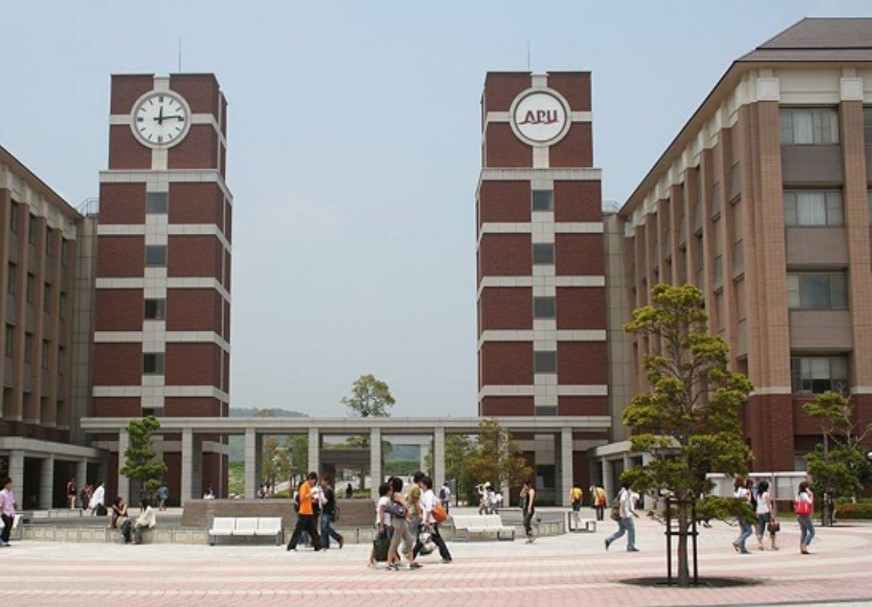
I was a visiting lecturer at Ritsumeikan Asia Pacific University [1] (APU) in Japan from 2006 to 2009. I taught Vietnamese to students attending the university, most of whom were Japanese, with a small number of students from other countries. They chose and voluntarily studied a foreign language they loved from among languages such as Chinese, Korean, Malaysian, Indonesian, Spanish, Thai, and Vietnamese.
At APU, students can study foreign languages regardless of their academic year or semester. To be accepted into the foreign language program, APU students must have English proficiency equivalent to an IELTS score of 5.5 or higher. Therefore, communication between teachers and APU students outside the curriculum had almost no language barriers. The luggage I brought to Japan to serve my profession was my knowledge of linguistics and the Vietnamese language (my target audience being people who knew nothing about the country, people, and language of Vietnam).
Although it was a Vietnamese language class, students often asked me questions about cultural knowledge. A Japanese female student said during the first class: "I only know Vietnam through my teacher and the blackboard." That sentence haunted me throughout my time teaching there. I felt torn between the task of teaching the language or the culture. How could Japanese students study Vietnamese while also learning about Vietnamese culture? Another time, a Vietnamese student who was the President of the Vietnamese Student Association, representing students studying at APU, came to me and asked a difficult question. She said the Association had a mission to support my teaching program to attract more students to learn Vietnamese. She said the Association would organize a music and dance performance with the theme of Vietnam to introduce it to students across the university. The thing she was worried about was how, through the performance, international students could see the Vietnamese identity. According to her, Vietnamese dances all originated from exchanges and borrowing from foreign countries. It was difficult for a Vietnamese language teacher like me to answer that question immediately. So, I told her I would answer later. Since that day, I immersed myself in reading and learning more about Vietnamese culture and history to help Japanese students as well as Vietnamese students understand the cultural characteristics of the Vietnamese people. Actually, I did that because I wanted to attract more students to learn Vietnamese through some features of Vietnamese culture. That was a stressful time for me because I had to face the fact that Japanese students were ignoring Vietnamese—the only language of a socialist country—to choose a popular foreign language with a large number of students at APU like Chinese or Korean... And then, I realized the value of national culture embedded in the language, creating a power to attract foreigners. More and more Japanese students chose to study Vietnamese at APU. Not stopping at learning the language, they went further, coming to the University of Social Sciences and Humanities, Viet Nam National University Ho Chi Minh City to attend intensive Vietnamese courses at the Faculty of Vietnamese Studies. Some of them are now employees of Japanese airlines linked with Vietnam Airlines flights. Some, from their early days in Japan, studying while checking the dictionary to see if they understood the words provided by the teacher correctly, have now graduated with a Bachelor's degree in Vietnamese Studies and completed a Master's degree in Sociology in Vietnam to continue their journey serving children with disabilities in Thanh Hoa. And there are many more good stories about Japanese students, starting with their connection to the Vietnamese language.
When teaching at APU, I focused on imparting knowledge and Vietnamese culture to Japanese students. Yet after three years, what I received back was not only professional experience but the quintessence, culture of Japan and other countries, gathered in one university environment. I often think that I gave a little but received too much. Remembering my time teaching at APU with beautiful memories flooding back is the luggage I carry throughout my teaching life. In my opinion, a teacher on the podium of a foreign university is also an image promoting Vietnam to the international community, in the sense of almost being a cultural ambassador of Vietnam. Therefore, we need to hone a lot of knowledge at the same time. In addition, for me, going abroad means learning many things; as long as you are diligent and serious in your work, you will complete your mission, but if you put in extra effort with a bit of creativity, the work will easily flourish, create a mark, and bring meaning to life. The educational philosophy that I distilled during my time working at APU has become the goal for my teaching and research when returning to work at my university.
Ho Chi Minh City, October 2018
[1] The Asia Pacific University (APU), part of the famous Ritsumeikan University in Japan, is a university in Southern Japan, located in the capital Beppu, belonging to Fukuoka city (the third largest city in Japan) in Oita province, Kyushu island. APU has relationships with 145 universities in nearly 50 countries, including 7 universities in Vietnam. The two main majors the university trains are College of Asia Pacific Studies and College of Asia Pacific Management with Master's and PhD programs. The school also has 105 student clubs in 4 areas: sports, scientific research, art culture, and society. Every year, the university has students from nearly 60 countries attending (data cited from an article posted on Tien Phong Sunday newspaper, issue 52-28/12/03).
Bài viết liên quan