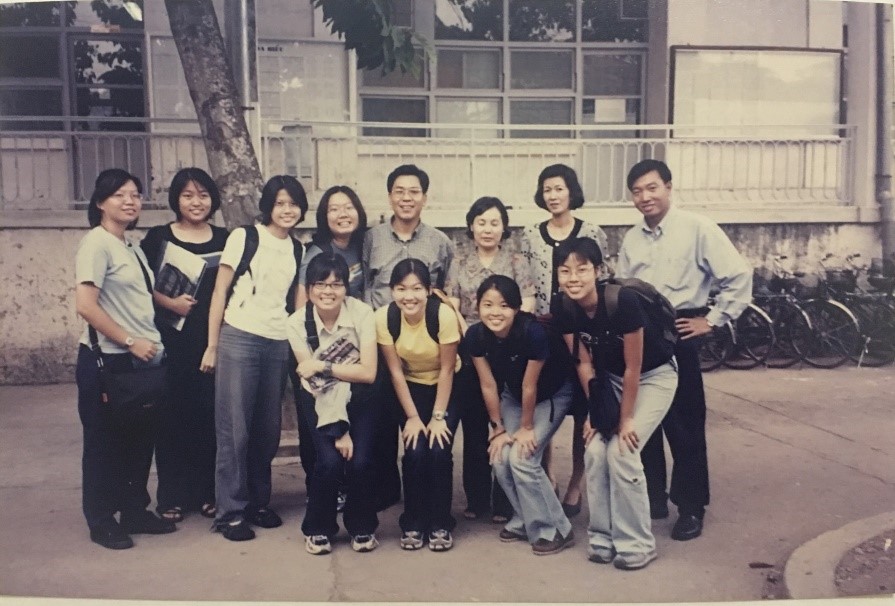
Assoc. Prof. Dr. Nguyen Van Lich
Time flies! It feels like only yesterday that I graduated from the University of Hanoi in 1970, yet nearly 50 years have passed! Our generation grew up during the years when the whole country was fiercely resisting the US to save the nation; many of my friends joined the army and went to the front, and some sacrificed their lives on the battlefield. I was fortunate enough to enter university, graduate with honors, and was on the list to be retained as a faculty member at the History Department. However, I did not want a relatively peaceful life in the lecture hall, so I volunteered to go to the Southern battlefield.
That was where my younger brother had falsified his age to volunteer to fight since after the Mau Than Tet Offensive. Life seemed to open doors, inviting us to step in to challenge ourselves and experience the reality of the nation's struggle. Knowing that hardship, challenges, and loss lay ahead, we were ready to accept it all.
We attended the Training Class for Young Writers (Course IV) organized by the Vietnam Writers' Association and were then assigned to various battlefields. I worked at the Propaganda and Education Department of the Central Office for South Vietnam from 1971 until the end of 1975, participating in the Ho Chi Minh Campaign in April 1975 and taking over the information, press, cultural, and educational agencies of the Republic of Vietnam government in Saigon. After several months working at the Military Management Committee of Saigon-Gia Dinh, from October 1975, I transferred to work at the University of Literature in Saigon...
From the end of 1978, I went to the Soviet Union as a doctoral student. I was fortunate to conduct research at the Institute of Oriental Studies, Moscow State University. My advisor was Prof. D.V. Deopik, one of the leading Vietnam studies scholars in the Soviet Union. My thesis topic was “The History of Soviet Historiography on the National Liberation Movement in Southeast Asia in the Modern Era”. Over four years of diligent study and research, I tried to accumulate knowledge about world history, the Soviet Union, the Far East, and Southeast Asia. The department where I studied was the Department of Far Eastern and Southeast Asian History, founded and developed by Academician A.A. Guber. I also learned about the Faculty of Oriental Studies at Leningrad State University, now Saint Petersburg. It was during these years that I nurtured the idea of building the disciplines of Oriental Studies/Southeast Asian Studies/Vietnamese Studies in Vietnam. I returned to the country in mid-1983 and resumed working at the Faculty of History, University of Ho Chi Minh City.
In 1984, I joined a field survey team from the University of Ho Chi Minh City in Kien Giang province to carry out the project Cultural Gazetteer of Kien Giang Province, led by Bui Khanh The. During those days, Mr. The and I discussed the proposal to establish a scientific research unit on Southeast Asia, which would also include Vietnam because our country belongs to this region. Later, in 1985, we wrote the Proposal for the establishment of a Vietnam-Southeast Asia research organization. At that time in Hanoi, within the system of the Vietnam Committee for Social Sciences, besides the traditional research institutes, the Southeast Asia Department and the Asia-Pacific Center had just been established; however, within the university system, the model of a research center/institute was still quite strange and novel. At that time, Bui Khanh The was the Vice President and Secretary of the Party Committee of the University. We discussed and convinced the university leadership, so the Proposal was submitted to the University Scientific Council for consideration. The council appreciated the idea and the content of the proposal, but there were still some concerns and reservations about the model and the feasibility of this project. After that, Bui Khanh The was appointed by the Ministry of Education as the head of a team of educational experts in Cambodia from 1986 to 1989, so the proposal did not progress.
By the end of 1989, after Mr. The completed his mission in Cambodia and returned to the university, we actively pushed for the aforementioned proposal. We collaborated with Sai Gon Giai Phong newspaper to organize a roundtable discussion on the urgency of training and researching Southeast Asia. The content of the roundtable was reported and published on more than half of page 2 of Sai Gon Giai Phong. The article attracted public attention and received positive feedback. Many phone calls from Ho Chi Minh City and Hanoi... were made to the University and the editorial office of Sai Gon Giai Phong, supporting the early establishment of a Southeast Asian training and research unit. The Proposal was revised and finalized, attached to the submission from the University of Ho Chi Minh City to the Ministry of Education and Training. At that time, at the University of Hanoi, the Ministry of Education and Training had decided to establish centers such as the Asia-Pacific Center, the Center for International Cooperation and Exchange, and the Center for Natural Resources and Environment. On March 14, 1990, the Minister of Education and Training signed the Decision to establish the Center for Vietnam and Southeast Asia Studies at the University of Ho Chi Minh City.
After receiving the Ministry's decision, Prof. Ly Hoa, the President, invited Bui Khanh The and me to discuss the human resources, content, and operating mechanism of the Center. According to the Minister's decision, the center had its own seal, own account, and self-accounting status. Thus, from the idea and proposal to the establishment of the center, it was a 5-year journey. But what to do to ensure the center's survival and development was much more difficult...
I still remember during the university's staff congress in October 1990, someone questioned: Why establish the Center for Vietnam and Southeast Asia Studies? In the West, they have the Oriental Studies discipline to study the East; we are Vietnam, a Southeast Asian country, so if we are good, we should study the West, America, rather than studying Vietnam or Southeast Asia... The congress spent quite a lot of time debating this issue...
Right from the beginning, we defined the motto of solidarity, consensus, and dedication to the existence and development of the Center for Vietnam and Southeast Asia Studies. Research here is applied research, so we did not delve into theoretical issues. Issues of Vietnamese studies, Southeast Asian studies, Oriental studies, and Area studies had already been researched by many. Vietnam is a Southeast Asian country, a part of the region, so it needs to be approached from two directions: from the inside (internal perspective) and from the outside (external perspective), from understanding ourselves then comparing with other subjects in Southeast Asia; from Southeast Asia expanding to neighboring countries in East Asia, South Asia, Asia-Pacific, and the world. Another motto was “using the short-term to support the long-term”, making the teaching of Vietnamese language and culture the top priority. Therefore, we focused on compiling a 6-level Vietnamese language textbook series (Vietnamese for Foreigners 1, 2, 3, 4, 5, 6) and supplementary books and materials. This task was well completed. After several years, there was a set of Vietnamese textbooks put into teaching, teaching while gaining experience, revising and supplementing annually. Only when it was highly evaluated by experts, students, and learners was it officially published by the Education Publishing House, and later by VNUHCM Press.
The year 1998 marked the development of Vietnamese studies in Vietnam and internationally. The first International Conference on Vietnamese Studies was solemnly organized at Ba Dinh Hall, Hanoi, gathering nearly 1000 people, including hundreds of leading international Vietnamese studies scholars (from European countries such as France, England, Russia, Germany, the Netherlands; the United States; Asian countries such as Japan, China, Korea, Laos, Cambodia, Thailand; Australia, etc.). The conference created a great momentum and push for the domestic Vietnamese studies sector to develop. Also that year, the University of Social Sciences and Humanities, Viet Nam National University Ho Chi Minh City, with keen awareness, decided to establish the Faculty of Vietnamese Studies based on the Department of Vietnamese Studies separated from the Center for Vietnam and Southeast Asia Studies. We seized the opportunity in time to promote the development of the Faculty of Vietnamese Studies. Thus, the second stage [1990-1998] was extremely important, laying the foundation for the development of the Faculty of Vietnamese Studies. That is first and foremost about the people. We set a requirement for all staff to study to improve their qualifications to Master's and Doctoral levels. We had to prepare facilities, from workplaces and classrooms to the library, because the library's books were not enough to meet the learning and research requirements. We had to expand cooperation relations both domestically and internationally. Without open international cooperation, there would be no students coming to study. Through international cooperation, we were forced to improve our professional qualifications and develop professional, agile working styles... to meet the requirements of partners.
Immediately after establishing the Faculty of Vietnamese Studies, we built a bachelor's training program in Vietnamese Studies under the credit system. At that time, the Vietnamese university sector was transitioning to the credit system, but thanks to cooperation with many foreign universities from before, we did not encounter any confusion and quickly caught up with the situation. After the university's Scientific Council approved the program, from the 1999-2000 academic year, the faculty began recruiting and training full-time bachelor's degree students in Vietnamese Studies for foreigners.
Not long after the establishment of the Faculty of Vietnamese Studies, I remember a meeting and conversation with Prof. Nguyen Tai Can, our country's leading linguist and Vietnamese studies scholar, when he visited the school. He said the gist was that the establishment of the Faculty of Vietnamese Studies was very timely and correct. Our country's science as a whole is still backward compared to the world; we have to study from others in natural sciences, technology, and even economics and social sciences and humanities... only one field does the world have to come to Vietnam and study from us, and that is Vietnamese studies. But if we want to be the teachers of the world, we must elevate ourselves; we must be good to be able to teach others. There are many people in the world who love and enjoy finding out about and studying Vietnam. Don't think we know everything about Vietnam! There are many very capable foreign Vietnamese studies scholars who have deep scientific methods and objective external approaches... They will be the ones to critique and contribute comments for us. Sometimes we have to learn from those foreign Vietnamese studies scholars! Whenever I recall the conversation with Prof. Nguyen Tai Can, I still find it profound.
Thanks to the solidarity and the scientific, hard work of all faculty and staff members, the Faculty of Vietnamese Studies has affirmed its role within the University of Social Sciences and Humanities. It was not a coincidence that the Vietnamese Studies training program was the first to undergo external assessment and reach the standards of the ASEAN University Network [AUN-QA] in January 2012.
I was fortunate to be entrusted with the task of building the Center for Vietnam and Southeast Asia Studies, the Faculty of Oriental Studies, and then the Faculty of Vietnamese Studies from the early days of “All beginnings are hard.” By gathering and uniting, we overcame initial difficulties to gradually develop and mature as we are today. The 20-year journey for a scientific discipline and a faculty is just the first baby steps. We need to strive even more to build an increasingly robust Faculty of Vietnamese Studies, contributing to making it a bridge between Vietnam and the world, so that international friends come to Vietnam more, understand Vietnam better, and contribute to implementing the Doi Moi policy in general and the open foreign policy of “Vietnam is a friend of all countries and a reliable partner of international friends.”
Bài viết liên quan