
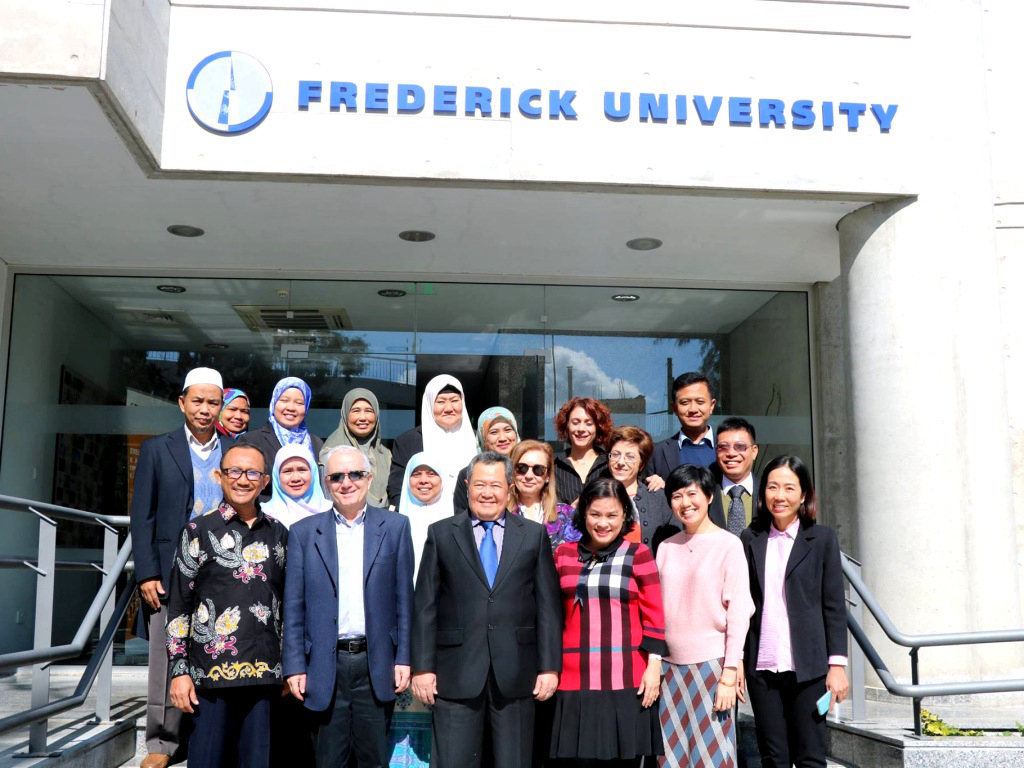
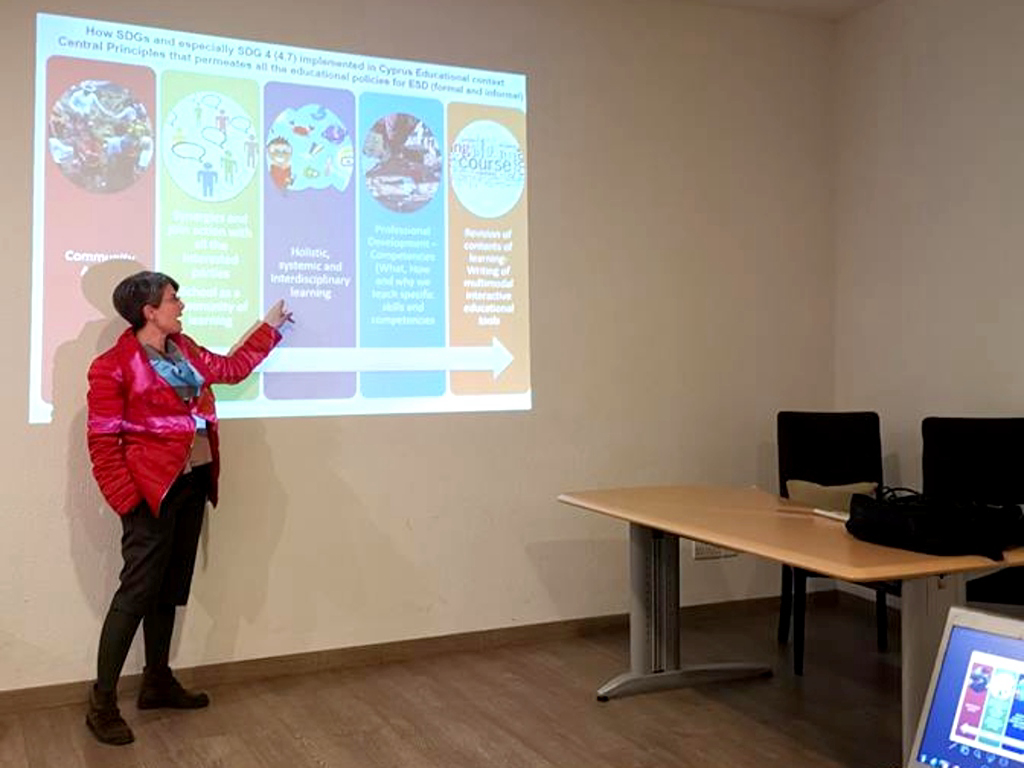
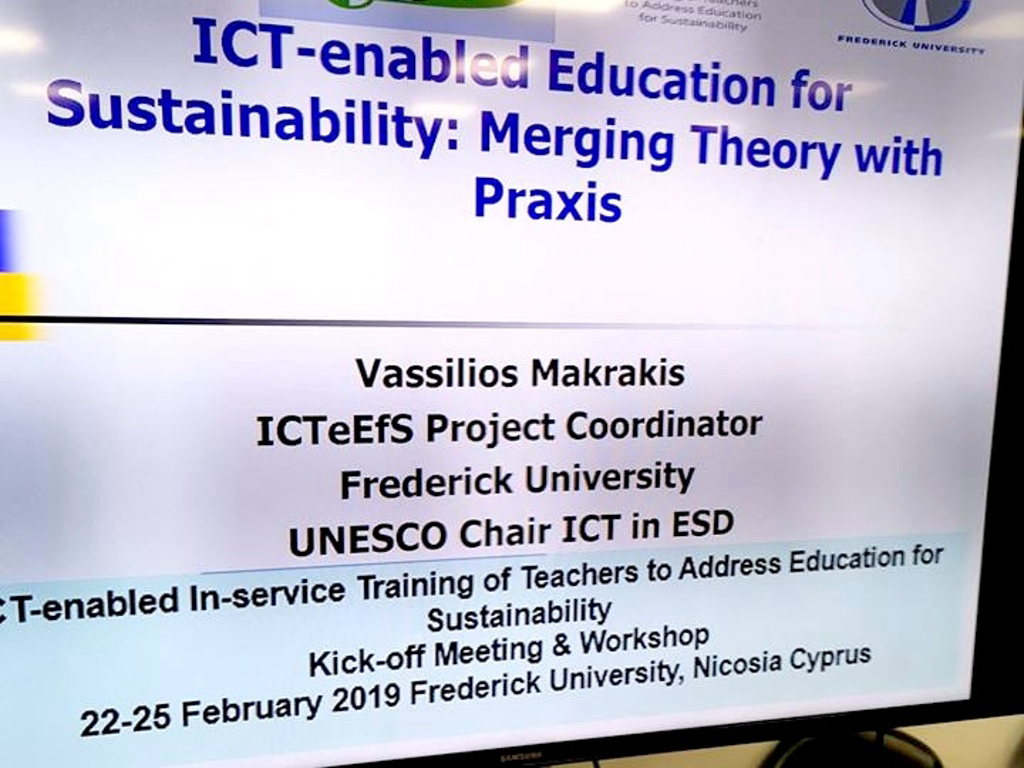
ICTeEfS is a European Commission ERASMUS plus Capacity Building in Higher Education (CBHE) funded project (Reference Number: 598623-EPP-1-2018-1-CY-EPPKA2-CBHE-JP) starting 15th January, 2019 and ending 14th January, 2022, entitled “ICT-enabled In-service Training of Teachers to address Education for Sustainability”. The ICTeEfS project focuses on seven Universities in Indonesia, Malaysia and Vietnam. The ICTeEfS project is coordinated by Prof. Dr. Vassilios Makrakis, at Frederick University, Cyprus.
ICTeEfS Aims and Objectives
Taking into consideration all the challenges and shortages described in the rationele, the proposed project aims at developing an ICT-enabled capacity-building program to in-service teachers and teacher educators and turn them able to use innovative teaching methodologies and pedagogies orienting to education for sustainability (EfS). The more specific objectives are to:
- Support the development of the faculties of education in partner universities to align curriculum, teaching, learning and research with the area of education for sustainability.
- Build capacity of academic staff at the faculties of education that will turn them able to contribute to the development, implementation and evaluation of a wide ICT-enabled in-service teachers training program on education for sustainability.
- Develop an efficient, cost-effective, decentralized, multiplier and innovative in-service teacher professional development program enabled by blended learning, focusing on the integration of education for sustainability across school curricula.
- Develop innovative teaching, learning and curriculum materials in the form of a multilingual e-Toolkit addressing the integration of education for sustainability in teaching, learning and curriculum.
- Develop a Euro-Asian Network of ICT-enabled Education for Sustainability to strengthen cooperation in the field of ICTeEfS and replicability of produced outputs and outcomes.
Expected Changes
The ways in which the situation set out under the rationale will be changed can be described as follows:
First, the ICTeEfS project will establish mechanisms at each partner country to contextualise ICT in Education for Sustainability (EfS) filling an existing gap that prevents policies towards building a more sustainable society, nationally and regionally.
Second, Faculties of Education in the partner countries’ institutions will have integrated education for sustainability themes in courses related to teaching methodology and curriculum, filling the current gap between school knowledge and real-life problems.
Third, there will be a shift from teacher-centered to student-centered instructional/learning designs enabled by ICTs, responding to the PCs educational reform initiatives. Merging ICTs with critical reflective pedagogies will enable target groups to see technology as a tool that can empower them to address real-life problems related to environment, society, economy and culture conducive to their country and region.
Fourth, teachers take investigative roles that help them discover and construct new understandings and knowledge. That, is, turning teachers able to reflect not only on their previous values and beliefs but also on the ethics dimension of teaching.
Fifth, by using participatory and collaborative learning approaches to teaching, learning and curriculum, trained teachers will expose positive attitudes to common efforts and collegiality, which were missing before.
Sixth, ICT coordinators, instead of putting most of their efforts to maintenance of ICT hardware and teaching about technology, there will shift to function as human resources able to carry out district/school-based teachers’ capacity building to advance EfS in teaching, learning and curricula.
ICTeEfs Rationale
One of the most visible side-effects of Asia’s rapid growth has been environmental damage. Recent climate-related disasters in the region show that Asian policy makers must act now to protect their citizens and mitigate and reverse the impacts of climate change to secure sustainable growth for the future. A way to rise to these challenges is through education for sustainability (EfS). While there is commitment of Asian leaders for EfS along with their concern for the implementation of Sustainable Development Goals (SDGs), the real change makers are the teachers in the classroom.
Malaysia, Indonesia and Vietnam are among the Asian countries, whose teaching force needs training to address the challenges posed by ICTs, climate change and other environmental threats. On the one hand, faculties of education need to reconstruct their study programs by integrating ICT-enabled Education for Sustainability (ICTeEfS) and, on the other hand, they have to capitalize on the potential of such technologies in advancing EfS to all subject in-service teachers. ICT literacy and rapidly growing availability of ICT infrastructure in the PCs makes the integration of ICT in the curriculum of teacher education programs and in-service training inevitable. However, integration of ICT does not merely mean an addition of ICT as a subject or tool. It implies changes about teaching and learning and requires comprehensive and integrative planning of the ICT-enabled EfS in teacher education.
Our needs analysis indicated that ICT teacher training programs in the partner countries often focus on the mechanics of ICT use rather than on ways to design curricular applications that would take advantage of the potential of ICT to bring about changes in the teaching and learning process and the curriculum. ICT coordinators have a huge responsibility in managing ICT matters, including the facilities, hardware and software, monitoring ICT activities, but much less on contributing to teachers’ professional development due to their lack of relevant training. It is thus a great challenge to tackle this problem and turn ICT coordinators into effective education leaders locally.
Most in-service training efforts are of short duration workshops (of 3 or 5 days), which act more as ad-hoc ‘orientation’ opportunities rather than sustained capacity-building processes of orienting teachers to EfS. There are also disparities within the partner countries, in particular, between rural-urban areas that affect the accessibility of teachers serving rural areas to their professional development. There is thus need for: 1) a shift of the current teaching/learning, mostly focusing on transmissive pedagogies to more constructivist and transformative pedagogies and 2) an alternative in-service teacher professional development program enabled by blended learning, taking into consideration all these gaps, barriers and neglected issues.
Source: https://icteefs.frederick.ac.cy/
Bài viết liên quan
![[BDCDNNGVĐH - K.08] Notice regarding the collection of certificates for the 08th Training Course on Professional Title Standards for University Lecturers](https://cms.hcmussh.edu.vn/api/file/bd801fbd-088e-4f27-820d-2355faad7ed4.png)
![[STEAM LK11] Admission announcement for the Integrated STEAM Teaching Methodology Course for Teachers - Course Code LK11 (60 Period)](/img/news/11040904.png?t=11040909)