|
|
|
Vietnamese Studies is defined as a scientific discipline that researches the land and people in all their relationships with nature, history, and society in every aspect, highlighting the characteristics and specific features of Viet Nam... |
|
Since its inception, Vietnamese Studies has not only been built and developed by generations of domestic scholars and researchers but has also attracted international experts and scientists. Recently, the international scientific conference "Issues in teaching Vietnamese language and researching Viet Nam in the contemporary world" took place in Ho Chi Minh City. The conference provided interesting insights into the development of Vietnamese Studies worldwide. Outlining the process of nearly 400 years of researching Viet Nam abroad, Assoc. Prof. PhD. Doan Le Giang, Dean of the Faculty of Vietnamese Studies, University of Social Sciences and Humanities, Viet Nam National University Ho Chi Minh City, stated: "Records about the land of Viet Nam can be seen as early as in the "Records of the Grand Historian" by Sima Qian during the Western Han dynasty, 1st century BC. Shortly after that were records in historical annals such as "Book of Han", "Book of the Later Han", "Book of Wei", "Records of the Three Kingdoms"... However, at that time, Viet Nam was only mentioned by countries in the "Sinosphere cultural area". It was not until globalization began in the 16th century that Viet Nam was mentioned more frequently in travelogues by missionaries, merchants, and Western explorers. The earliest was the book "Decades of Asia, the actions that the Portuguese took in the conquest and discovery of the sea and land in the East" by the Portuguese linguist Joao de Barros (1496-1570), first published in Lisbon in 1563, which contains records about Viet Nam's Con Dao. But it was not until the 1621 "Rhodes' Cochinchina" (Xứ Đàng Trong) by Cristophoro Borri (1583-1632) that there was a coherent, scientific record specifically about Viet Nam by a European. Therefore, Borri can be considered the first foreign "Vietnamese Studies" scholar. And the time of the birth of "Xứ Đàng Trong" was a milestone for the field of Vietnamese Studies to officially step out to the five continents".
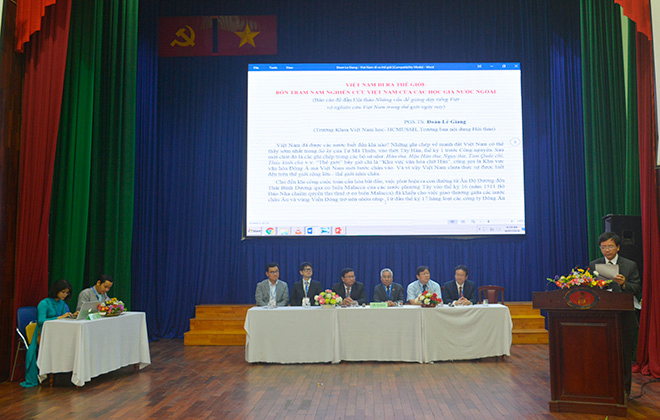
Delegates presenting papers at the international conference "Issues in teaching Vietnamese language and researching Viet Nam in the contemporary world". To date, Vietnamese Studies is not only a strongly developing discipline in regional countries such as China, Japan, Korea, Thailand, Russia... but has also reached the US, Germany, France... Here, research and translation works on Viet Nam's history, society, religion, culture, and literature... are strongly developing. According to Assoc. Prof. Ye Shao Fei, Honghe University, Yunnan, China, in the early years of the 21st century, the research of Vietnamese Nom characters in China developed very strongly, focusing mainly on the fields of history and literature research. Many research topics and works have been published, and specialized journals on Vietnamese Nom studies have also appeared more and more frequently. Now, modern Vietnamese literary works are also being translated and widely introduced in China. In Japan specifically, the heroic resistance of the Vietnamese people for independence and freedom, which lasted for decades, has created deep interest among the intellectuals of this country in the history and culture of Viet Nam. According to the research of Assoc. Prof. PhD. Doan Le Giang, the exploration of Viet Nam in Japan began quite early; from the early 1930s, there were scattered works. By the 1940s, the number of articles, travelogues, translated books, and research on Viet Nam had increased significantly. From the early 1960s to the present, Vietnamese literature has been translated, researched, and introduced in Japan in large quantities and systematically, making Japan one of the leading countries in researching Vietnamese literature in the world. Famous generations of Japanese researchers can be mentioned: Matsumoto Nobuhiro, Takeuchi Yonosuke, Imai Akio, Shiraishi Masaya, Takano Isao... In which, the first research work on Vietnamese classical literature by a Japanese scholar is probably "Bibliography of Nom books of the Ecole Francaise d'Extreme-Orient in Hanoi" carried out by Matsumoto Nobuhiro in 1933. In addition, famous works such as "Truyen ky man luc" by Nguyen Du, "The Tale of Kieu" by Nguyen Du, "Prison Diary" by President Ho Chi Minh, "Luc Van Tien" by Nguyen Dinh Chieu, and works by Phan Boi Chau... are also researched in depth by the intellectuals of the Land of the Rising Sun, not only regarding the works themselves but also the life and thoughts of the authors. Careful research methods, focusing on data, objective perspectives, and applying advanced research methods make the literary research of Japanese scholars have special values, with a unique position compared to research from other countries. The focus on literature shows that the Japanese scholarly community wants a basic, deep understanding of Vietnamese culture. Prof. Shimizu from Osaka University also provided many historical sources proving that the Vietnamese language was known and recorded in Japan very early: mid-18th century through two sets of memoirs titled "An Nam quoc phieu luu vat ngu" and "Nam Bieu ky". According to PhD. Dao Muc Dich, University of Social Sciences and Humanities, Viet Nam National University Ho Chi Minh City, research on the East in general and Viet Nam in particular in the West was formed and developed from about the 16th-17th centuries, associated with the need for proselytization and commercial and political exchanges between many European countries and Viet Nam. During these centuries, many Western navigators, explorers, merchants, and missionaries... came to Viet Nam. They recorded in travelogues, chronicles, or research works what they saw and heard, the interesting things about the country and people of Viet Nam in comparison with the West. Through the eyes of witnesses, they breathed into their works and research authentic things and interesting experiences. Besides Cristophoro Borri with "Xứ Đàng Trong" (1621), some typical authors and works writing about Viet Nam during this period also include: Alexandre de Rhodes with "History of the Kingdom of Tonkin" (1650), Jean Baptiste Tavernier with "New and Interesting Travelogue of the Kingdom of Tonkin 1639 - 1645" (1681)... Besides that, Western scholars also published works on the Vietnamese language, Vietnamese grammar, or Vietnamese-foreign language dictionaries, such as Alexandre de Rhodes with "Brief Report on the Annamese or Tonkinese language" and "Vietnamese-Portuguese-Latin Dictionary". By the 18th century and the first half of the 19th century, the number of authors and works in the field of Vietnamese Studies decreased sharply compared to the previous century due to political and diplomatic turmoil and trade relations... between Western countries and the Vietnamese feudal government. Vietnamese Studies in particular, as well as the study of the Far East in general, only officially became an academic discipline in the West during the French colonial period. In 1900, the Ecole Francaise d'Extreme-Orient was established in Hanoi and later became the most important center gathering French and Western Vietnamese Studies scholars. Among them were many famous scholars researching Viet Nam such as Henry Maspero, Leonard Aurousseau, Leopold Cadiere, Emile Gaspardonne... Publications about Viet Nam during this period were highly academic, having deep scientific value in many fields such as history, ethnology, sociology, archaeology, agriculture, Vietnamese linguistics... To date, research on Viet Nam in France has become widespread and has achieved many important results, especially in-depth works on the history of modern Viet Nam. In the US, Vietnamese Studies began quite late: formed from the first half of the 20th century and especially during the war in Viet Nam. In general, research on Viet Nam in the US is usually combined with Southeast Asia and researches in a direction tending towards ancient and modern Viet Nam. The team of researchers on Viet Nam in the US are scientists, academic circles, university professors..., typically including David Marr with the works "Vietnamese Anticolonialism 1885-1925" and "Vietnamese Tradition on Trial"; John K. Whitmore with "Vietnam, Ho Quy Ly and the Ming: 1371-1421"; Peter B. Zinoman with "The Colonial Bastille: A History of Imprisonment in Vietnam, 1862-1940" and the translated work "Dumb Luck" (Số đỏ) of Vu Trong Phung into English.... Although they were latecomers, American scientists were pioneers in innovating approaches and research methodologies for Vietnamese Studies to help this scientific discipline take new steps forward. Viet Nam has long been known to the world as the focal point for the struggle movement of colonial nations in the 20th century and, more recently, as a model for successful renovation (Doi Moi). The country and people of Viet Nam, with their 4,000 years of unique cultural history, have become an interesting and attractive subject of research for foreign historians and scientists. Their research contributes to promoting the beauty and the depth of culture and society of the S-shaped strip of land to friends on five continents. At the same time, those research achievements also provide us with an outside perspective, the objective assessments of international friends about our own people and country. Phan Thi Uyen
|
||